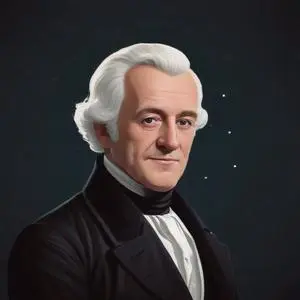
William Herschel: The Celestial Maestro
A Discoverer of Worlds and Sounds
William Herschel is renowned for being the first person to discover a planet since antiquity, the majestic Uranus, and for his groundbreaking contributions to astronomy, music, and beyond. This German-British astronomer and composer's remarkable journey began on November 15, 1738, and took him to the pinnacle of scientific fame.
The Early Years: Music and Military
Born in the Electorate of Hanover, Herschel followed his father's footsteps into the military band of Hanover, where he honed his musical skills. In 1757, he emigrated to Great Britain at the age of nineteen, further refining his musical talents. This early exposure to music would later influence his approach to astronomy, as he often described the harmony of the celestial bodies.
The Astronomical Pursuits
In 1774, Herschel constructed his first large telescope, marking the beginning of his astronomical endeavors. Over the next nine years, he conducted exhaustive sky surveys to investigate double stars. His meticulous efforts resulted in the publication of two seminal catalogues of nebulae, featuring 2,500 objects in 1802 and 5,000 objects in 1820.
The Discovery of Uranus
On March 13, 1781, while making observations, Herschel noted a new object in the constellation of Gemini. After weeks of verification and consultation with fellow astronomers, this new planet was confirmed, and Herschel became an overnight sensation. He named the planet Georgium Sidus (George's Star) in honor of King George III, who later appointed him Court Astronomer.
Pioneering Spectrophotometry and Infrared Radiation
Herschel pioneered the use of astronomical spectrophotometry, employing prisms and temperature measuring equipment to measure the wavelength distribution of stellar spectra. During these investigations, he made the groundbreaking discovery of infrared radiation, expanding our understanding of the electromagnetic spectrum.
Additional Achievements
- Improved determination of the rotation period of Mars
- Discovery of the Martian polar caps' seasonal variations
- Identification of Titania and Oberon, moons of Uranus
- Discovery of Enceladus and Mimas, moons of Saturn
Honors and Legacy
Herschel was knighted in 1816 and became the first President of the Royal Astronomical Society in 1820. His legacy extends beyond his discoveries, as he inspired generations of astronomers and scientists. Today, the Herschel Space Observatory, launched in 2009, continues to explore the universe, a testament to his enduring impact.
Personal Life and Relationships
Herschel often collaborated with his younger sister,
Caroline Herschel, a fellow astronomer. Their close bond and shared passion for astronomy led to numerous joint discoveries and a lifelong partnership.
Trivia and Fun Facts
- Herschel was a talented oboist and composer, writing over 20 symphonies.
- He was a strong advocate for the importance of astronomy, stating, "The whole of astronomy is a mystery, and that mystery is a puzzle."
In conclusion, William Herschel's multifaceted life, marked by his groundbreaking discoveries, musical talents, and pioneering spirit, has left an indelible mark on the fields of astronomy, music, and beyond.
FAQ
What was William Herschels most significant astronomical discovery?
William Herschels most significant astronomical discovery was the discovery of the planet Uranus in 1781, which he named Georgium Sidus (Georges Star) in honor of King George III.
What was William Herschels contribution to the field of astronomy?
William Herschel made significant contributions to the field of astronomy, including the discovery of two moons of Saturn, two moons of Uranus, and the detection of infrared radiation.
How did William Herschels musical background influence his astronomical work?
William Herschels musical background influenced his astronomical work, as he applied his musical skills to the study of astronomical harmonies and the discovery of celestial bodies.
What was William Herschels role in the discovery of binary stars?
William Herschel played a significant role in the discovery of binary stars, identifying over 800 double stars during his career and providing evidence for the existence of multiple star systems.
What was William Herschels legacy in the field of astronomy?
William Herschels legacy in the field of astronomy is that of a pioneering astronomer who expanded our understanding of the solar system and the universe beyond.