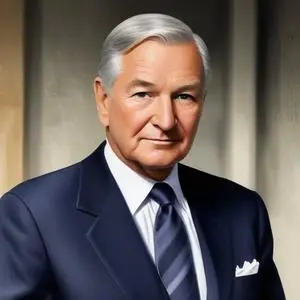
David Rockefeller: The Visionary Banker and Pillar of American Finance
A Life of Unparalleled Impact
David Rockefeller, the renowned American economist, investment banker, and philanthropist, left an indelible mark on the world of finance and beyond. As the chairman and chief executive of Chase Manhattan Corporation, he spearheaded the bank's growth into a global financial powerhouse, earning him a reputation as one of the most influential figures in modern banking.
Early Life and Education
Born on June 12, 1915, in New York City, David Rockefeller was the youngest of six children to John Davison Rockefeller Jr. and Abigail Greene Aldrich. His family's storied legacy in finance and philanthropy set the stage for his future endeavors. Rockefeller's educational pursuits were marked by excellence, graduating cum laude from Harvard University in 1936, where he worked as an editor on The Harvard Crimson. He furthered his studies in economics at the London School of Economics under the tutelage of Friedrich von Hayek.
A Career of Distinction
Rockefeller's professional journey began at Chase National Bank, which later merged with Bank of Manhattan to form Chase Manhattan Corporation. His ascent through the ranks was swift, becoming chairman and chief executive in 1969. During his tenure, he navigated the bank through tumultuous economic times, including the 1970s oil crisis and the 1980s Savings and Loan crisis. His visionary leadership transformed Chase into a global financial institution, with a presence in over 50 countries.
Philanthropic Pursuits and Personal Milestones
Rockefeller's commitment to philanthropy was unwavering, with a focus on education, healthcare, and international development. He served on the board of the Rockefeller Brothers Fund, the Rockefeller Foundation, and the Council on Foreign Relations. In 1940, he married Margaret "Peggy" McGrath, with whom he had six children. His personal milestones include being awarded the Presidential Medal of Freedom in 1998 and receiving the honorary title of Knight Commander of the Order of the British Empire in 2002.
Influence on Modern Society
David Rockefeller's impact on modern society extends far beyond the realm of finance. His diplomatic efforts facilitated international dialogue, earning him a reputation as a seasoned statesman. He played a key role in shaping the United States' foreign policy, serving as a trusted advisor to several presidents. His diplomatic prowess helped to ease Cold War tensions, facilitating dialogue between the United States and the Soviet Union.
Controversies and Public Perception
Rockefeller's career was not without controversy. Critics accused him of exercising undue influence over the global financial system, while others viewed him as a symbol of American economic imperialism. Despite these criticisms, his commitment to philanthropy and public service remains unwavering.
Quotes and Memorable Sayings
"I don't think I've ever been in a situation where I've been forced to do something I didn't want to do."
Historical Context and Legacy
David Rockefeller's passing on March 20, 2017, marked the end of an era in American finance. His life's work serves as a testament to the power of visionary leadership, philanthropy, and public service. As a patriarch of the Rockefeller family, his legacy continues to inspire generations of business leaders, policymakers, and philanthropists.
Personal Relationships and Anecdotes
Rockefeller's personal relationships were marked by warmth and humility. His close friendship with
Henry Kissinger, former Secretary of State, was a testament to his ability to forge strong bonds with global leaders. Anecdotes from his personal life, such as his love of modern art and his passion for flying, humanize a figure often revered for his professional prowess.
Awards and Honors
- Presidential Medal of Freedom (1998)
- Knight Commander of the Order of the British Empire (2002)
- Doctor of Laws, Harvard University (1959)
- Doctor of Humane Letters, University of Pennsylvania (1964)
Charitable Work and Social Contributions
Rockefeller's philanthropic endeavors were far-reaching, with a focus on education, healthcare, and international development. His charitable work continues to have a lasting impact on communities around the world.
Final Thoughts
David Rockefeller's life serves as a testament to the power of vision, perseverance, and public service. As a towering figure in American finance and beyond, his legacy continues to inspire generations of leaders, policymakers, and philanthropists.
FAQ
What was David Rockefellers role in the banking industry?
David Rockefeller was the CEO of Chase Manhattan Bank and played a key role in shaping the global banking industry, serving as a leader in international finance.
What was David Rockefellers early life like?
David Rockefeller was born on June 12, 1915, into a prominent banking family, and was educated at Harvard University and the University of Chicago.
What were some of David Rockefellers philanthropic efforts?
David Rockefeller was a dedicated philanthropist, supporting institutions such as the Museum of Modern Art and the Rockefeller Brothers Fund, and was a key figure in the creation of the Trilateral Commission.
What was David Rockefellers role in international relations?
David Rockefeller played a key role in shaping international relations, serving as a trusted advisor to several US presidents and playing a key role in the development of the Americas Society.
What was David Rockefellers legacy?
David Rockefellers impact on global finance, philanthropy, and international relations has left a lasting legacy, shaping the course of modern history.