


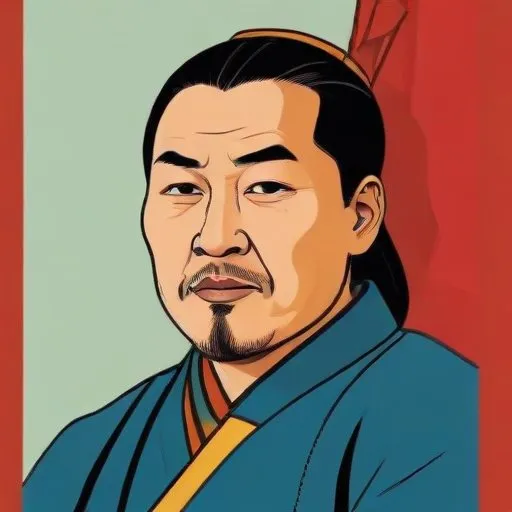
A Mongol prince and politician who led Mengjiang, a Japanese-backed puppet state in Inner Mongolia during World War II, known for his efforts to unify Mongolians and resist Chinese rule. He played a significant role in shaping the region's modern history.
Demchugdongrub, also known as Prince De, was a Qing dynasty Chinese Mongol prince who lived during the 20th century and became the leader of an independence movement in Inner Mongolia. He is most notable for being the chairman of the pro-Japanese Mongol Military Government and later of the puppet state of Mengjiang during the Second Sino-Japanese War.
Demchugdongrub was born on February 8, 1902, in Chahar Province, Qing dynasty. He was the sole son of Namjil Wangchuk, the Duoluo Duling Junwang of the Snid Right Banner and Chief of the Xilingol League. His name consists of the Tibetan words Chakrasamvara and Siddhartha, respectively.
After his father's death in 1908, the six-year-old Demchugdongrub inherited one of his father's titles, the Duoluo Duling Junwang, with the approval of the Qing. In his youth, he studied the Mongolian, Chinese, and Manchu languages.
After the fall of the Qing, Yuan Shikai promoted Demchugdongrub to the title of Jasagh Heshuo Duling Jinong in 1912. This marked the beginning of his rise to power in the region.
In the 1930s, Demchugdongrub became the leader of an independence movement in Inner Mongolia, seeking to establish a unified Mongol state. During this time, he collaborated with the Japanese, who were seeking to expand their empire in East Asia.
In 1939, Demchugdongrub became the chairman of the pro-Japanese Mongol Military Government, and later the chairman of the puppet state of Mengjiang from 1939 to 1945.
During his leadership, Demchugdongrub implemented policies aimed at promoting Mongolian culture and identity, while also collaborating with the Japanese to maintain control over the region.
Demchugdongrub's legacy is complex and contested. Some view him as a Mongol nationalist who promoted the unity and autonomy of the Mongol people, while others see him as a traitor who collaborated with the Japanese during World War II.
Despite the controversy surrounding his legacy, Demchugdongrub remains an important figure in modern Mongolian history, and his impact on the region's politics and culture continues to be felt today.
Demchugdongrub married twice, first to a daughter of a Taiji Qing aristocratic title nobleman from his own Snid Right Banner, and then to Fujin, a daughter of another Taiji nobleman from the Abaga Banner. He had five children, including four sons and one daughter.
Demchugdongrub passed away on May 23, 1966, at the age of 64.
Demchugdongrub's legacy continues to shape modern Mongolian identity and politics. His promotion of Mongolian culture and autonomy has inspired generations of Mongolian nationalists, while his collaboration with the Japanese has raised questions about the morality of his actions.
Today, Demchugdongrub remains a controversial figure, with some hailing him as a hero and others condemning him as a traitor. However, his impact on modern Mongolian history is undeniable, and his legacy continues to be felt in the region.
73 Years Old
A renowned Chinese violinist and composer, blending Eastern and Western musical styles, creating a unique sound that showcases cultural fusion.
Born in 1897
Vice President of the Republic of China from 1954 to 1965, known for his role in Taiwan's government and diplomatic efforts during the Cold War era.
