


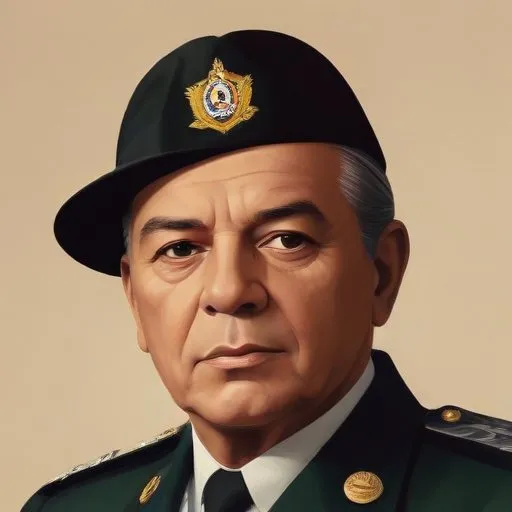
Brazil's first president, a military leader who oversaw the country's transition from empire to republic, known for his role in shaping the nation's early years.
Deodoro da Fonseca is revered as the first president of Brazil, hailed for his instrumental role in the country's transition from a monarchical empire to a republic. With a storied military career and a reputation for personal courage, Fonseca's leadership paved the way for Brazil's modern era.
Born on August 5, 1827, in Alagoas, Brazil, Fonseca was destined for a life of service. His family's military tradition dates back to his father, Manuel Mendes da Fonseca Galvão, and his brother, Severino Martins da Fonseca, who was nominated the first Baron of Alagoas. Fonseca's own military career began at a young age, with notable achievements including the suppression of the Praieira revolt in Pernambuco in 1848 and his bravery during the Paraguayan War (1864-1870). He rose through the ranks, ultimately attaining the rank of field marshal in 1884 and later becoming a full marshal.
Fonseca's military prowess and charismatic leadership earned him widespread recognition, making him a national figure. As Governor of Rio Grande do Sul, he was courted by republican intellectuals, including Benjamin Constant and Ruy Barbosa, who saw in him a leader capable of guiding Brazil towards a new era of governance.
In 1889, Fonseca played a pivotal role in overthrowing the Empire of Brazil, toppling Emperor Pedro II from power. This marked the beginning of the First Brazilian Republic, with Fonseca taking office as provisional president. He later went on to win the presidential election in 1891, solidifying his position as the first elected president of Brazil.
Fonseca's presidency was marked by controversy and political turmoil. He faced opposition from various factions, including the National Congress, which he eventually dissolved in 1891. This decision led to widespread protests and calls for his resignation, ultimately resulting in his stepping down from office the same year.
Fonseca's legacy extends far beyond his presidency. He played a crucial role in shaping Brazil's modern identity, paving the way for future generations of politicians and leaders. His commitment to republicanism and his willingness to challenge the status quo continue to inspire Brazilians to this day.
Fonseca passed away on August 23, 1892, less than a year after leaving office. His memory lives on in the town of Marechal Deodoro, Alagoas, which was renamed in his honor.
Fonseca's life and legacy serve as a testament to the power of courage, conviction, and leadership. His unwavering commitment to the principles of republicanism continues to inspire Brazilians, earning him a permanent place in the country's history books.
Fonseca's remarkable story serves as a beacon of hope for those seeking to bring about meaningful change, cementing his place as one of Brazil's most enduring figures.
Born in 1847
The 6th President of Brazil, a key figure in the country's early 20th-century development, known for modernizing the nation's infrastructure and economy. He's also recognized for his role in establishing the country's Supreme Court.
