


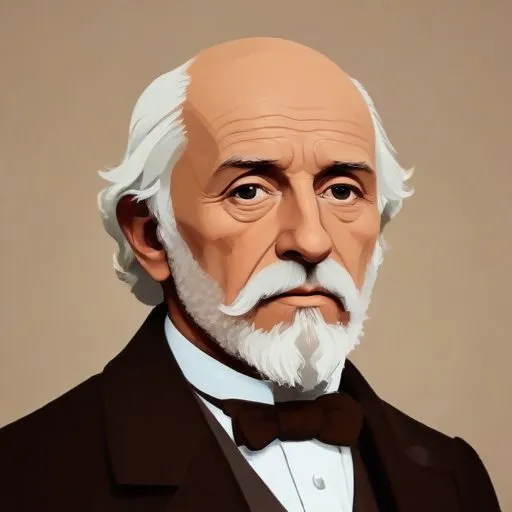
A pioneer of classical liberalism, he advocated for individual rights, limited government, and constitutional monarchy, influencing modern democratic thought.
Benjamin Constant, a renowned French-Swiss philosopher, is famously known for his significant contributions to the development of modern liberalism and his influential writings on political theory, religion, and romantic love. His ideas not only shaped the political landscape of Europe during the early 19th century but also continue to impact contemporary society.
Born on October 25, 1767, in Lausanne, Switzerland, Constant was a member of the Constant de Rebecque family, descendants of French Huguenots who fled from Artois to Switzerland during the French Wars of Religion. He received his education in Brussels, Paris, and Edinburgh, where he developed a deep fascination with philosophy and literature.
Constant is celebrated for refining the concept of liberty, defining it as a condition of existence that allows the individual to turn away from interference from the state or society. His ideas emphasized the importance of individual freedom, civil liberties, and the protection of human rights. He advocated for a constitutional monarchy and a system of government that would safeguard individual liberties and prevent authoritarian rule.
Constant's literary career spanned over three decades, during which he wrote numerous essays, novels, and philosophical treatises. Some of his notable works include:
Constant's ideas have had a profound impact on modern society, shaping the development of liberal democracy and influencing political movements across Europe and Latin America. His concept of liberty as a fundamental human right has inspired generations of politicians, philosophers, and social reformers.
Constant's life was marked by significant events that shaped his thoughts and philosophy. He was a committed republican and supported the coup d'état of 18 Fructidor (1797) and the following one on 18 Brumaire (1799). He also sided with Napoleon during the Hundred Days and became a prominent figure in the French Restoration.
Constant was elected as a member of the French Academy in 1824 and received numerous accolades for his contributions to literature and philosophy.
Benjamin Constant's legacy extends beyond his literary and philosophical contributions. He was a fervent advocate for individual liberty, democratic governance, and human rights, making him a pioneer of modern liberalism. His ideas continue to inspire and influence contemporary political discourse, cementing his place as one of the most important thinkers of the 19th century.
In conclusion, Benjamin Constant's remarkable life and work have left an indelible mark on modern society. His commitment to individual liberty, democracy, and human rights has inspired generations of thinkers and continues to shape the world we live in today.
Born in 1769
A French military leader who rose to prominence during the French Revolution and became Emperor of France, known for his military conquests and reorganization of Europe. He is also famous for his Napoleonic Code, which remains a foundation of modern law.
Born in 1712
A pioneering thinker who shaped modern democracy and education with his ideas on social contracts, general will, and the importance of early childhood education. His writings influenced the French Revolution and modern political thought.
Born in 1694
A witty and insightful 18th-century writer and philosopher who used satire to critique societal norms and advocate for reason, tolerance, and human rights.
Born in 1724
Developed influential philosophical frameworks, such as the Critique of Pure Reason, that shaped modern Western thought on ethics, morality, and human understanding.
Born in 1806
A prominent 19th-century thinker who championed individual liberty, free speech, and women's rights, and is best known for his influential book "On Liberty".
Born in 1770
A German philosopher and academic who developed a comprehensive and systematic philosophy that emphasized the unity of all things and the dialectical process of thesis, antithesis, and synthesis. His ideas have had a profound impact on modern thought, influencing fields such as philosophy, politics, and art.
Born in 1905
Existentialist philosopher and playwright who argued that humans have complete freedom to choose their actions and create their own meaning in life, influencing modern thought on morality and individual responsibility.
