


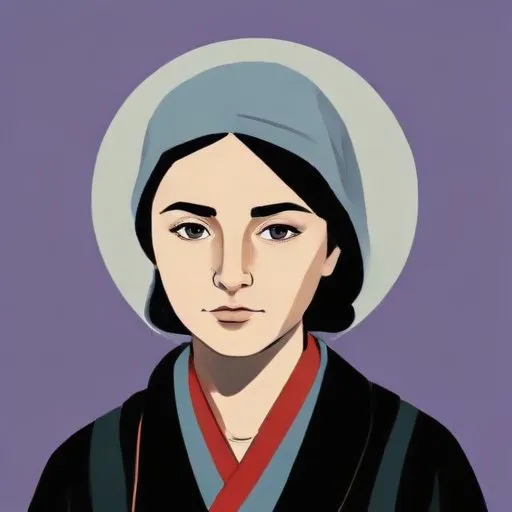
A renowned Serbian poet and academic, celebrated for her lyrical and introspective works that explore themes of love, nature, and national identity. Her poetry is characterized by its musicality and emotional depth.
Desanka Maksimović, one of Serbia's most celebrated poets, writers, and translators, left an indelible mark on the country's literary landscape with her extensive body of work that spanned over seven decades. Known for her poignant poetry, which often delved into themes of love, mortality, and social commentary, Maksimović's writing continues to captivate readers to this day, earning her a revered position in Serbian literary circles.
Maksimović's foray into the world of literature began in the early 1920s, when her works were first published in the literary journal Misao. While studying at the University of Belgrade, she quickly gained recognition for her unique writing style, which seamlessly blended lyricism with social insight. Her poems soon found their way into the prestigious Serbian Literary Herald, solidifying her position as a rising star in the literary world.
In 1925, Maksimović received a French Government scholarship to pursue a year of study at the University of Paris. This period had a profound impact on her writing, as she was exposed to the works of influential European writers and intellectuals. Upon her return to Serbia, she was appointed professor at Belgrade's elite First High School for Girls, a position she held until the outbreak of World War II.
In 1933, Maksimović married Sergej Slastikov, a Russian émigré writer, in a union that would last for over three decades. The couple shared a deep love for literature and intellectual pursuits, fostering a creative environment that allowed Maksimović's writing to flourish.
During World War II, Maksimović's life took a dramatic turn. Dismissed from her teaching position by the German occupation, she was forced to struggle for survival, taking on odd jobs to make ends meet. However, she continued to write in secret, compiling a collection of patriotic poems, including the iconic "Krvava bajka" (A Bloody Tale), which commemorated the Kragujevac massacre.
This powerful poem, penned in 1941, became an anthem of resistance against the Nazi occupation, and was frequently recited at post-war commemorative ceremonies. It remains one of Maksimović's most celebrated works, testifying to her unwavering commitment to her country and her art.
In 1958, on the occasion of her 60th birthday, Maksimović received a string of honours and awards, solidifying her position as a national literary treasure. Six years later, she published one of her most acclaimed works, Traim pomilovanje (I Seek Clemency), which contained veiled critiques of the Tito government. This volume cemented her status as a poet of unflinching integrity and intellectual courage.
In 1965, Maksimović was inducted as a full-fledged member of the Serbian Academy of Sciences and Arts, a testament to her profound influence on the country's cultural heritage.
Following her husband's death in 1970, Maksimović's poetry increasingly focused on the themes of human mortality and the passage of time. Her travels abroad during the 1970s and 1980s inspired several works that showcased her remarkable ability to capture the essence of diverse cultures and experiences.
Desanka Maksimović's life and work serve as a beacon of inspiration for future generations of writers, poets, and intellectuals. Her legacy is a testament to the transformative power of literature, which has the ability to capture the essence of human experience and convey it in a way that transcends time and borders.
"I write to understand, to see, to hear, to be. I write to express the inexpressible, to grasp the unattainable."
Desanka Maksimović's poetry and prose have had a profound impact on modern Serbian society, influencing generations of writers, intellectuals, and artists. Her commitment to expressing the human condition, despite the challenges she faced, continues to inspire and motivate individuals from all walks of life.
Born in 1892
A Yugoslav writer who crafted poignant stories and poems that explored the human condition, earning him the Nobel Prize in Literature. His works continue to captivate readers with their emotional depth and historical significance.
Born in 1893
A Serbian poet and author who explored themes of identity, love, and war in his avant-garde works, blending elements of surrealism and futurism. His writing often reflected the turmoil of his homeland during World War I and the subsequent Yugoslav Wars.
Born in 1922
A prominent figure in Serbian literature, known for his unique and imaginative poetry that explores the human condition, blending myth and reality.
