


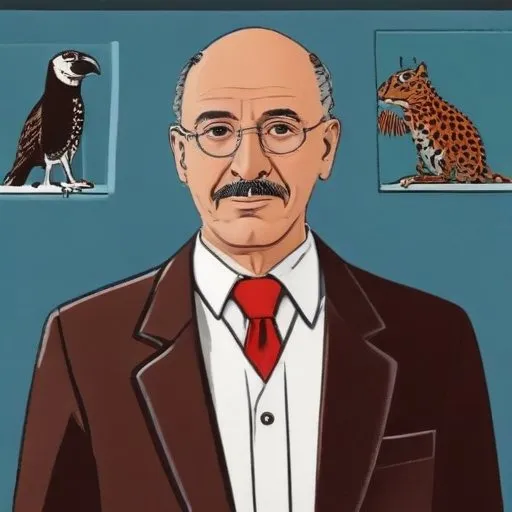
A renowned zoologist, ethologist, and painter who explored human behavior and animal instincts through groundbreaking books and art, most famously "The Naked Ape".
Desmond Morris, a renowned English zoologist, ethologist, and surrealist painter, is best known for his groundbreaking 1967 book "The Naked Ape", a provocative exploration of human behavior and biology. His work, which continues to influence modern thought, has made him a household name, synonymous with insightful and often controversial observations on human nature.
Born on January 24, 1928, in Purton, Wiltshire, Morris grew up in a family that encouraged his curiosity and creativity. His father, Harry Morris, was a children's fiction author, and his mother, Marjorie, nurtured his love for natural history. This upbringing laid the foundation for Morris's future endeavors, which would seamlessly blend art, science, and storytelling.
After serving in the British Army, Morris pursued his passion for zoology, studying at the University of Birmingham and later earning a Ph.D. from the University of Oxford. His research on animal behavior, particularly the reproductive behavior of the tenspined stickleback, laid the groundwork for his future writings. In the 1950s, Morris began to explore the intersection of art and science, creating surrealist paintings and films that showcased his unique perspective.
"The Naked Ape", Morris's magnum opus, was a deliberate attempt to challenge societal norms and conventions. The book's success was met with both acclaim and criticism, as Morris's blunt and often provocative observations on human sexuality, aggression, and social behavior sparked heated debates. Despite the controversy, the book remains a seminal work, influencing generations of scientists, anthropologists, and writers.
Morris's television career, which spanned several decades, included hosting Zoo Time and creating over 500 programs on animal behavior and zoology. His work in film, including the surrealist shorts "Time Flower" and "The Butterfly and the Pin", showcased his innovative approach to storytelling.
Morris's work has been shaped by his belief in the importance of understanding human behavior through a scientific lens. He has consistently challenged traditional notions of human nature, arguing that our behavior is fundamentally influenced by our biology and evolution. This perspective has led to both praise and criticism, cementing Morris's reputation as a provocative and thought-provoking thinker.
Desmond Morris's work has had a lasting impact on modern society, influencing fields as diverse as anthropology, psychology, and sociology. His ideas have also permeated popular culture, inspiring authors, filmmakers, and artists. As a pioneer in the field of human sociobiology, Morris continues to inspire new generations of thinkers and researchers.
Desmond Morris's legacy is a testament to the power of provocative ideas and intellectual curiosity. While his work has sparked controversy and debate, it has also contributed significantly to our understanding of human nature. As a true original, Morris has left an indelible mark on modern thought, ensuring that his ideas will continue to inspire and challenge us for generations to come.
Born in 1903
A renowned expert in animal behavior, he pioneered the study of instinct and imprinting, and is famous for his work on aggression and his book "On Aggression".
Born in 1907
A pioneering scientist who studied animal behavior, particularly in birds, and developed key concepts in ethology, earning a Nobel Prize for his groundbreaking work. His findings greatly advanced our understanding of instinct, learning, and social behavior.
92 Years Old
Renowned for groundbreaking chimpanzee research and tireless conservation efforts, this trailblazing scientist has greatly advanced our understanding of primates and the natural world.
94 Years Old
Renowned for groundbreaking research on mountain gorillas, this dedicated scientist fought tirelessly to protect these magnificent creatures and their habitats.
Born in 1854
A German physician and biologist who discovered the first effective treatment for syphilis and developed the concept of chemotherapy, earning a Nobel Prize in Physiology or Medicine in 1908.
97 Years Old
A renowned biologist and author who has made groundbreaking contributions to our understanding of ecology, evolution, and conservation, and is known for his advocacy for biodiversity and the preservation of natural habitats.
