


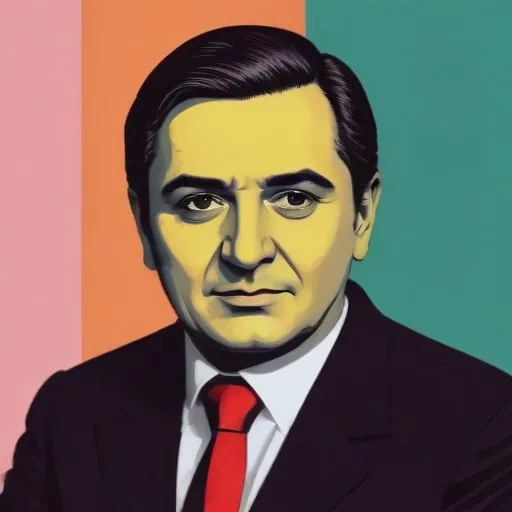
A prominent Georgian publicist and author, known for his influential writings on national identity, social issues, and politics in 19th-century Georgia. His works played a significant role in shaping the country's intellectual and cultural landscape.
Dimitri Kipiani was a Georgian statesman, publicist, writer, and translator who dedicated his life to promoting the Georgian culture and society, ultimately sacrificing his freedom and life for this noble cause. He is renowned for his relentless efforts to preserve Georgian identity and independence, earning him the reverence of his people and the title of saint in the Georgian Orthodox Church.
Born on April 14, 1814, in the village of Mereti near Gori, Georgia, then part of Imperial Russia, Kipiani hailed from a noble family. After graduating from the Tiflis School of Nobility in 1830, he worked as a teacher, instilling in him a strong sense of responsibility and commitment to education.
However, his life took a dramatic turn when he participated in the 1832 Georgian plot against Russian rule, which led to his deportation to Vologda. During his exile, he briefly worked for the local governor's chancellery, an experience that would shape his future endeavors.
After his return to Georgia in 1837, Kipiani entered the civil service and held various positions at the viceregal office until 1864. During this period, he emerged as a prominent spokesman for liberal nobility, advocating for the rights and freedoms of his people.
One of his most significant contributions was his involvement in the emancipation reform, where he was tasked with devising a plan to free Georgian serfs. Although his plan did not provide land ownership to the serfs, it marked a crucial step towards their liberation.
Kipiani's leadership and dedication to his people earned him several esteemed positions, including Marshal of the Nobility of the Tiflis and Kutaisi guberniyas from 1864 to 1870 and from 1879 to 1886, respectively. He also served as the mayor of Tiflis from 1876 to 1879.
In 1886, his unwavering commitment to Georgian independence led to his exile and subsequent murder at the hands of Russian Imperial authorities. This tragic event shocked the nation, cementing Kipiani's status as a national hero and martyr.
In 2007, the Georgian Orthodox Church canonized Kipiani as a saint, honoring his sacrifices and unwavering dedication to his people. His legacy continues to inspire generations, serving as a powerful symbol of resistance against oppression and a testament to the indomitable spirit of the Georgian people.
Kipiani's struggle for Georgian independence has left an indelible mark on modern society. His courage and perseverance have inspired countless individuals to fight for their rights and freedoms, transcending generations and borders.
Today, Georgians celebrate Kipiani's life and legacy as a beacon of hope, a reminder of the power of resistance, and a testament to the importance of preserving cultural heritage.
Born in 1837
A Georgian journalist, lawyer, and politician who played a key role in the country's struggle for independence and is considered the "Father of Georgian Nationalism". He's most known for his literary works and advocacy for social and political reforms.
Born in 1876
A pioneering Georgian historian and academic who made significant contributions to the field of Caucasus studies, particularly in the areas of history, philology, and archaeology.
Born in 1893
A celebrated Georgian writer and public figure, known for his influential novels and poetry that explored themes of love, freedom, and national identity. His works are considered classics of Georgian literature.
