


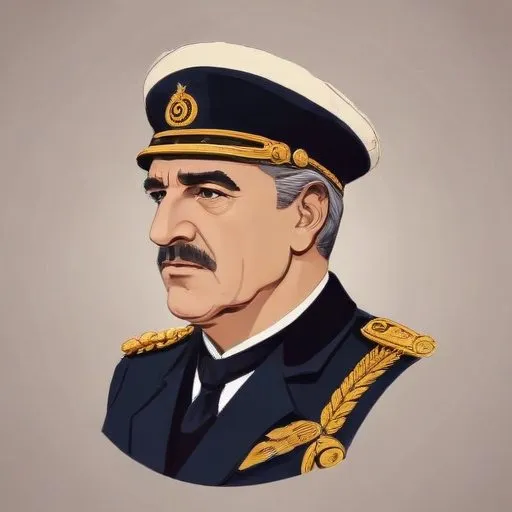
A Greek general and politician who played a key role in the Greek War of Independence against the Ottoman Empire, leading several successful battles and later serving as a minister.
Dimitris Plapoutas, a renowned Greek general, fought valiantly during the Greek War of Independence against the Ottoman Empire, leaving an indelible mark on the country's history. Born in 1786, Plapoutas's bravery and strategic prowess played a crucial role in liberating Greece from Ottoman rule.
Plapoutas was born in Paloumba, Arcadia, in the Peloponnese region of the Ottoman Empire. His father, Kollias Plapoutas, hailed from a strong line of Arvanites of Greek Orthodox religion from Epirus. This heritage would later earn him the nickname "Koliopoulos" from Theodoros Kolokotronis.
In 1811, Plapoutas left Paloumba for the Ionian Islands, where he became an officer in the 1st Regiment Greek Light Infantry. Seven years later, he joined the Filiki Eteria, a secret society determined to liberate Greece from Ottoman control.
During the Greek War of Independence, Plapoutas took part in several pivotal battles, including the Siege of Tripolitsa, the capture of the Acrocorinth, the Battle of Valtetsi, and the Battle of Maniaki. His military prowess and unwavering dedication to the cause earned him recognition as a respected leader among his peers.
After Greece gained independence, Plapoutas supported Prince Otto of Bavaria as the King of Greece, along with General Theodoros Kolokotronis and General Kitsos Tzavelas. However, he later opposed the Bavarian-dominated regency during King Otto's rule, leading to his imprisonment at the Palamidi in 1834. He was sentenced to death but later pardoned in 1835.
Plapoutas went on to serve in the Greek Parliament from 1844 to 1847 and in the Senate from 1847 to 1862. He was also made an honorary bodyguard of King Otto and entrusted with escorting him to his new kingdom.
Plapoutas had a brother, Georgios, who fought alongside him in many battles and died in the Battle of Lalas. In his later years, Plapoutas married a woman in her thirties and had one child, a girl named Athanasia. He passed away shortly after, leaving behind a legacy of bravery, honor, and dedication to his country.
Today, Plapoutas's house still stands, albeit heavily damaged from an earthquake in the 1960s, in his hometown of Paloumba. The house serves as a testament to his enduring legacy and a reminder of the sacrifices he made for Greece's freedom.
Dimitris Plapoutas's remarkable life and unwavering commitment to Greece's independence serve as an inspiration to generations to come. His legacy continues to be felt in the country's history, politics, and cultural heritage.
Born in 1907
A Greek lawyer and politician who served as President of Greece, known for leading the country's transition from military dictatorship to democracy. He's credited with modernizing Greece and joining the European Union.
Born in 1888
A Greek lawyer, economist, and politician who served as the Prime Minister of Greece from 2009 to 2011, known for his efforts to address the country's debt crisis.
Born in 1864
A Greek statesman who played a crucial role in shaping modern Greece, leading the country through significant reforms and transformations. He's known for his visionary leadership and diplomatic prowess.
Born in 1871
A Greek general and politician who served as the 130th Prime Minister of Greece, known for his authoritarian regime and opposition to the Axis powers during World War II. He implemented a series of reforms and modernization projects, but also suppressed political opposition and civil liberties.
Born in 1883
A Greek general and politician who served as Prime Minister of Greece, known for his efforts to stabilize the country during a time of political turmoil. He played a key role in shaping Greece's post-war government.
Born in 1902
A Greek philosopher and politician who served as the 138th Prime Minister of Greece, known for his brief but significant term during a tumultuous period in Greek history. He played a key role in shaping the country's post-war politics.
