


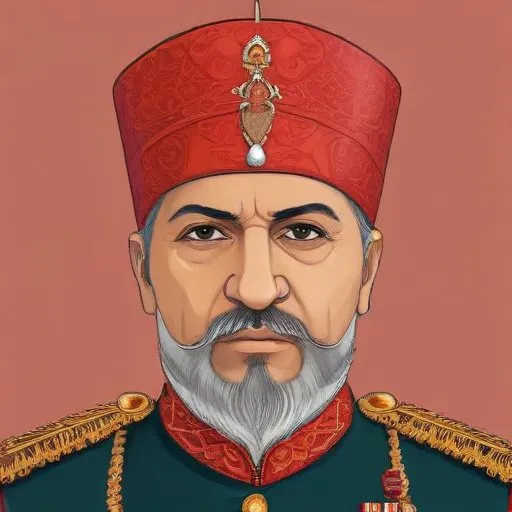
An Ottoman general who served as the Minister of Navy during World War I, known for his brutal suppression of Arab nationalism and his role in the Armenian Genocide.
Djemal Pasha, also known as Ahmed Cemal Pasha, was a renowned Ottoman military leader who played a pivotal role in shaping the fate of the Ottoman Empire during World War I. As one of the Three Pashas, he ruled the empire alongside Enver Pasha and Talaat Pasha, leaving an indelible mark on the nation's history.
Born on May 6, 1872, in Mytilene, Lesbos, Djemal Pasha was the son of Mehmed Nesib Bey, a military pharmacist. He graduated from Kuleli Military High School in 1890 and completed his studies at the Military Academy Mektebi Harbiyeyi Şahane in Istanbul in 1893. His early career saw him serving in various capacities, including as a staff commander of the Novice Division and as an inspector of Rumelia Railways.
Djemal Pasha's sympathies with the Committee of Union and Progress (CUP) led to his appointment as a major in 1905. He subsequently became a key figure in the Balkan Wars, serving on the frontlines in Salonica. His military prowess earned him recognition, and he was given the command of Constantinople after the Raid on the Sublime Porte.
Djemal Pasha's three-year rule in Syria was marked by authoritarianism, which alienated the local population who opposed Turkish nationalism. His policies, however, were not as deadly as those of other CUP leaders, as he favored the forced assimilation of Armenians over outright extermination.
Djemal Pasha's role in the Armenian Genocide remains a topic of controversy, with some seeing him as a perpetrator and others as a relatively more moderate figure. Nevertheless, his actions during this period have left a lasting impact on the history of the region.
Djemal Pasha's rivalry with Mustafa Kemal Atatürk, later the founder of modern Turkey, is well-documented. The two men had fundamentally different visions for the future of the Ottoman Empire, with Atatürk advocating for a more secular and democratic state.
Djemal Pasha's beliefs were shaped by his commitment to the ideals of the Committee of Union and Progress. He saw the Ottoman Empire as a bastion of Islamic identity and believed in the importance of preserving its unity and integrity.
Djemal Pasha's legacy continues to shape the politics and identity of the modern Middle East. His actions, both positive and negative, have left an enduring impact on the region's history, making him a figure of continued study and debate.
In conclusion, Djemal Pasha's remarkable life and career serve as a testament to the complexities and contradictions of the Ottoman Empire during its twilight years. As we reflect on his legacy, we are reminded of the importance of understanding the past in order to forge a better future.
Born in 1881
Ottoman Empire's Minister of War and leader of the Young Turk revolution, known for his role in World War I and the Armenian Genocide.
Born in 1881
Founder of modern Turkey, leading the country's transition from the Ottoman Empire to a secular, democratic nation, and implementing sweeping reforms in education, law, and women's rights.
Born in 1884
Led Turkey's transition to a secular, democratic state, and played a key role in the country's modernization. He's remembered for his efforts to establish a strong, independent Turkey.
Born in 1876
A Turkish field marshal and politician who served as Prime Minister of the Turkish Provisional Government, playing a crucial role in the country's transition from Ottoman Empire to modern republic. He's known for his military victories and political leadership during a tumultuous period in Turkish history.
Born in 1861
The last Sultan of the Ottoman Empire, ruling from 1918 to 1922, known for his brief and tumultuous reign marked by the empire's collapse and eventual abolition.
Born in 1882
A Turkish general and politician who played a key role in the country's War of Independence and later served as the 5th Speaker of the Grand National Assembly of Turkey. He's known for his military victories and contributions to modern Turkey's foundation.
