


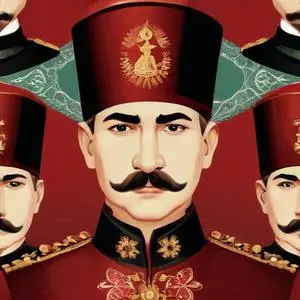
Ottoman Empire's Minister of War and leader of the Young Turk revolution, known for his role in World War I and the Armenian Genocide.
Enver Pasha, born Ismail Enver, was a Turkish military officer, revolutionary, and convicted war criminal who played a pivotal role in the Ottoman Empire's descent into chaos during World War I. As one-third of the dictatorial triumvirate known as the Three Pashas, along with Talaat Pasha and Cemal Pasha, Enver's actions led to the deaths of hundreds of thousands of Armenians, Assyrians, and Greeks.
Enver's journey to notoriety began in Ottoman Macedonia, where he joined the Committee of Union and Progress (CUP), a organization affiliated with the Young Turkey movement. The CUP sought to overthrow Sultan Abdul Hamid II's despotic rule, and Enver's involvement in the 1908 Young Turk Revolution earned him recognition as a hero of the revolution.
However, multiple crises in the Empire, including the 31 March Incident, the Balkan Wars, and the power struggle with the Freedom and Accord Party, led Enver and the Unionists to become disillusioned with liberal Ottomanism. This disillusionment paved the way for Enver's rise to power, as he became War Minister and de facto Commander-in-Chief after the 1913 Ottoman coup d'état.
As War Minister, Enver led a disastrous attack on Russian forces in the Battle of Sarikamish, which he blamed on Armenians. This sparked a wave of violence against Armenian, Assyrian, and Greek populations, resulting in the deaths of between 800,000 and 1,800,000 Armenians, 300,000 Assyrians, and 750,000 Greeks. Enver, along with Talaat, is held responsible for these atrocities, which are now recognized as the Late Ottoman Genocides.
Following the Ottoman Empire's defeat in World War I, Enver, along with other leading Unionists, escaped the Empire. The Ottoman Military Tribunal convicted him and other Unionists in absentia for bringing the Empire into World War I, sentencing them to death.
Enver Pasha's legacy is one of violence, destruction, and genocide. His actions had far-reaching consequences, shaping the modern Middle East and leaving a scar on the region's history. Today, Enver Pasha serves as a cautionary tale about the dangers of nationalism, militarism, and the unchecked power of individuals.
Born in 1872
An Ottoman general who served as the Minister of Navy during World War I, known for his brutal suppression of Arab nationalism and his role in the Armenian Genocide.
Born in 1881
Founder of modern Turkey, leading the country's transition from the Ottoman Empire to a secular, democratic nation, and implementing sweeping reforms in education, law, and women's rights.
Born in 1876
A Turkish field marshal and politician who served as Prime Minister of the Turkish Provisional Government, playing a crucial role in the country's transition from Ottoman Empire to modern republic. He's known for his military victories and political leadership during a tumultuous period in Turkish history.
Born in 1861
The last Sultan of the Ottoman Empire, ruling from 1918 to 1922, known for his brief and tumultuous reign marked by the empire's collapse and eventual abolition.
