


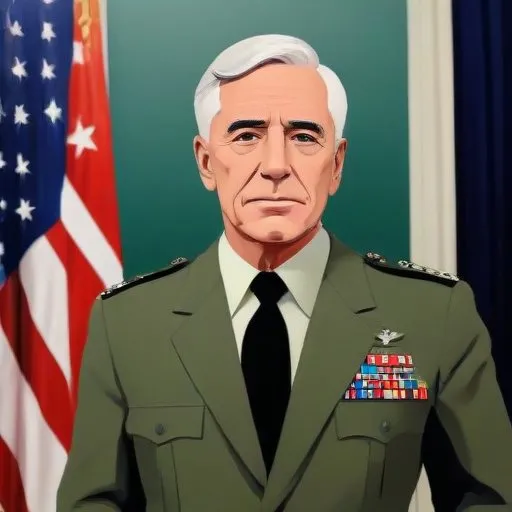
The 11th White House Chief of Staff, serving under President Ronald Reagan, played a crucial role in shaping the administration's economic and foreign policy agendas. He's infamous for his clashes with First Lady Nancy Reagan and eventual resignation.
As the 66th United States Secretary of the Treasury and later White House Chief of Staff, Donald Regan played a pivotal role in shaping the economic policies of the Reagan administration. He is best known for advocating Reaganomics, a economic philosophy centered on tax cuts, deregulation, and reduced government spending, which aimed to stimulate economic growth and create jobs.
Born on December 21, 1918, in Cambridge, Massachusetts, Regan was the son of Kathleen (née Ahearn) and William Francis Regan, of Irish Catholic origins. He earned his Bachelor of Arts in English from Harvard College in 1940 and attended Harvard Law School before dropping out to join the Marine Corps at the outset of World War II.
Regan served in the Pacific Theater, participating in five major campaigns, including Guadalcanal and Okinawa, and reached the rank of lieutenant colonel. After the war, he joined Merrill Lynch in 1946 as an account executive trainee, where he worked his way up the ranks, eventually becoming the firm's chairman and CEO in 1971, a position he held until 1980.
As chairman and CEO of Merrill Lynch, Regan was a key figure in the modernization of Wall Street. He was a strong proponent of brokerage firms going public, which he believed was essential for the industry's growth. Under his leadership, Merrill Lynch had its initial public offering in 1971, becoming the second Wall Street firm to go public.
In 1981, Regan was appointed Secretary of the Treasury by President Ronald Reagan, a position he held until 1985. As Secretary, he played a crucial role in implementing Reaganomics, which centered on tax cuts, deregulation, and reduced government spending. He was a strong advocate for the Economic Recovery Tax Act of 1981, which lowered tax rates and stimulated economic growth.
In 1985, Regan was appointed White House Chief of Staff, a position he held until 1987. During his tenure, he oversaw the White House staff and played a key role in advising the President on policy matters.
Donald Regan's legacy is deeply intertwined with the economic policies of the Reagan administration. His advocacy for Reaganomics and tax cuts helped stimulate economic growth and create jobs. While his tenure as Chief of Staff was marked by controversy, his impact on the economic landscape of the 1980s remains significant.
Regan married Ann George Buchanan in 1942, and the couple had four children. He passed away on June 10, 2003, at the age of 84.
Donald Regan's life and career were marked by significant accomplishments and controversy. However, his impact on the economic policies of the Reagan administration remains a lasting legacy of his service to the United States.
Born in 1911
The charismatic leader who championed conservative policies, helped end the Cold War, and is often credited with restoring American pride and optimism. He's also remembered for his folksy, actor-honed communication style.
Born in 1921
The 42nd First Lady of the United States was an actress and activist who played a crucial role in the "Just Say No" anti-drug campaign and supported her husband's presidential policies. She was a fashion icon and a prominent figure in the White House during the 1980s.
Born in 1924
The 41st President of the United States, a decorated war hero and skilled diplomat, led the country through the end of the Cold War and Gulf War. He's known for his foreign policy expertise and "kinder, gentler nation" vision.
96 Years Old
The 61st United States Secretary of State, a skilled diplomat and strategist, played a crucial role in shaping global politics during the Gulf War and beyond. He's known for his exceptional negotiation skills and ability to build international coalitions.
Born in 1917
A decorated military officer and lawyer who served as Secretary of Defense, playing a key role in shaping US foreign policy and military strategy during the Cold War. He's most known for his hawkish stance and significant military budget increases.
Born in 1920
An American economist and politician who served as the 60th United States Secretary of State, playing a key role in shaping foreign policy during the Cold War era. He's known for his diplomatic efforts to end the Cold War and his advocacy for economic freedom.
