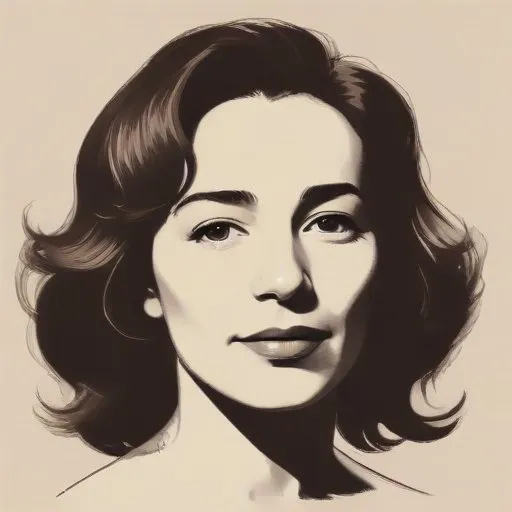
Dorothea Tanning: A Pioneering American Artist
Early Life and Influences
Dorothea Tanning, a renowned American painter, printmaker, sculptor, writer, and poet, is best known for her innovative and provocative works that blended elements of Surrealism, abstraction, and fantasy. Born on August 25, 1910, in Galesburg, Illinois, Tanning was the second of three daughters to Swedish immigrant parents, Andrew Peter Tanning and Amanda Marie Hansen.
Tanning's early life was marked by a strong connection to her Scandinavian heritage, which would later influence her artistic style. After graduating from Galesburg Public High School in 1926, she worked at the local library and attended Knox College, where she developed an interest in art and literature.
The Emergence of an Artist
In 1930, Tanning moved to Chicago, where she began to pursue a career in art, working as a commercial artist while honing her skills as a painter. Five years later, she relocated to New York City, a hub of artistic innovation, where she became acquainted with the Surrealist movement at the Museum of Modern Art's 1936 exhibition, Fantastic Art, Dada and Surrealism. This encounter had a profound impact on her artistic trajectory, inspiring her to experiment with new techniques and themes.
Rise to Prominence
Tanning's talent was soon recognized by the art world, and in 1941, she was introduced to Julien Levy, a prominent gallery owner, by the art director at Macy's department store. Levy was impressed by her work and offered her a solo exhibition in 1944, followed by another in 1948. This exposure launched Tanning's career, and she became a prominent figure in the Surrealist circle, befriending artist
Max Ernst and his wife,
Peggy Guggenheim.
Artistic Contributions and Style
Tanning's artistic style was characterized by its unique blend of realism, abstraction, and fantasy. Her works often featured dreamlike landscapes, biomorphic forms, and surreal creatures, which were both poetic and unsettling. She explored a range of mediums, including painting, printmaking, sculpture, and poetry, and was known for her innovative use of materials and techniques.
- Her early works, such as Birthday (1942) and Eine Kleine Nachtmusik (1943), showcased her mastery of Surrealist techniques, featuring distorted forms and eerie landscapes.
- In the 1950s and 1960s, Tanning's style shifted towards abstraction, exemplified in works like Hôtel du Pavot, Chambre 202 (1970-1973) and Recherché de la Vérité (1964).
- Her later works, such as Truck Me (1974) and Pennies, Politics, and Poetry (1975), revealed a more playful and whimsical side, incorporating elements of humor and satire.
Personal Life and Relationships
Tanning's personal life was marked by significant relationships, including her brief marriage to writer Homer Shannon in 1941 and her close friendship with Max Ernst, whom she met in 1942. Her correspondence with Ernst and his wife, Peggy Guggenheim, provides valuable insights into the artistic circle of the time.
Legacy and Impact
Dorothea Tanning's contributions to modern art are immense. She was a pioneering female artist who defied conventions and pushed the boundaries of Surrealism, abstraction, and fantasy. Her innovative style and techniques have inspired generations of artists, including feminist artists of the 1970s and 1980s. Today, her works are held in high esteem, with many residing in prominent museum collections, including the Museum of Modern Art, the Tate Modern, and the Centre Pompidou.
Tanning's legacy extends beyond her artistic output, as she played a significant role in shaping the artistic landscape of the 20th century. Her life and work serve as a testament to the power of creativity, innovation, and determination.
FAQ
What inspired Dorothea Tannings surrealist artwork?
Dorothea Tannings surrealist artwork was inspired by her fascination with the subconscious mind and the world of dreams. Her paintings and sculptures often featured fantastical creatures and abstract forms, blurring the line between reality and fantasy.
How did Dorothea Tannings poetry reflect her artistic style?
Dorothea Tannings poetry was known for its lyricism and imagination, echoing the surrealist themes found in her visual art. Her poetry often explored the boundaries of language and meaning, creating a dreamlike atmosphere that mirrored her artistic style.
What role did Dorothea Tanning play in the Surrealist movement?
Dorothea Tanning was an important figure in the Surrealist movement, contributing to the development of surrealist art and literature. Her work was exhibited alongside other prominent surrealist artists, including Max Ernst, with whom she had a romantic relationship.
How did Dorothea Tannings artistic style evolve over time?
Dorothea Tannings artistic style underwent significant changes throughout her career, moving from figurative painting to abstract sculpture and eventually incorporating textiles and other materials. Her style remained rooted in surrealist principles, but became more experimental and innovative.
What is Dorothea Tannings most famous artwork?
Dorothea Tannings most famous artwork is arguably Birthday, a 1942 painting that features a dreamlike, self-portrait of the artist surrounded by mythical creatures. The painting is considered a seminal work of surrealist art and is widely regarded as one of Tannings masterpieces.