


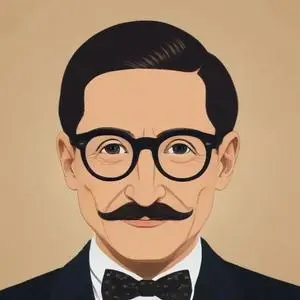
A pioneering artist who challenged conventional norms by submitting a urinal as art, sparking a revolution in conceptual art and questioning the very definition of art itself.
Marcel Duchamp, a French-American artist, is renowned for his pioneering work in conceptual art, Dadaism, and Surrealism, challenging traditional notions of art and its purpose. Alongside Pablo Picasso and Henri Matisse, he is considered one of the most influential artists of the 20th century, transforming the way we think about art, its creation, and its reception.
Duchamp was born on July 28, 1887, in Blainville-Crevon, Normandy, France, into a family that cherished art and intellectual pursuits. His maternal grandfather, Émile Frédéric Nicolle, was a painter and engraver, whose art filled the family home. Marcel's family encouraged his creativity, and he developed a close bond with his sister Suzanne, with whom he shared a passion for games and imaginative play.
In his early twenties, Duchamp became disillusioned with the traditional art world, which he felt was solely focused on aesthetics. He sought to create art that engaged the mind, not just the eye. This led him to reject the work of many of his contemporaries, including Henri Matisse, and to explore new forms of artistic expression.
Duchamp's most significant contribution to modern art is his concept of the "readymade," where everyday objects are elevated to the status of art by the artist's selection and presentation. He famously submitted a urinal, titled "Fountain," to the Society of Independent Artists in 1917, challenging the very definition of art. This provocative gesture paved the way for conceptual art, questioning the role of the artist, the nature of creativity, and the boundaries between art and life.
Besides his artistic endeavors, Duchamp was an avid chess player and a strong amateur. He saw parallels between chess and art, both requiring strategic thinking, creativity, and a willingness to challenge conventions. His passion for chess influenced his artistic approach, as he sought to outmaneuver his opponents in the art world, just as he would on the chessboard.
Duchamp's relationships with his family and friends were instrumental in shaping his artistic vision. His sister Suzanne, with whom he shared a lifelong bond, often modeled for his early paintings. His brothers, Jacques Villon and Raymond Duchamp-Villon, were also artists, and their collaborations and critiques influenced Marcel's development as an artist.
Duchamp's groundbreaking work has had a profound impact on modern art, challenging traditional norms and pushing the boundaries of creativity. His concept of the readymade has inspired generations of artists, from Surrealists to Conceptualists, and continues to influence contemporary art practices.
Duchamp's artistic philosophy centered on the idea that art should engage the mind, not just the eye. He believed that creativity should be a process of intellectual inquiry, rather than mere aesthetics. Through his work, he sought to question the authority of the art world and to redefine the role of the artist as a thinker, rather than a mere craftsman.
Marcel Duchamp's legacy extends far beyond his own art practice, influencing generations of artists, curators, and art historians. His pioneering work in conceptual art, Dadaism, and Surrealism has reshaped the way we understand art, its creation, and its reception. As a true visionary, Duchamp continues to inspire new artistic movements and challenge our perceptions of what art can be.
Born in 1881
A pioneering artist who transformed modern art with pioneering Cubist works, creating a new visual language that continues to inspire and influence art, design, and culture.
Born in 1869
A pioneering artist who revolutionized modern art with bold, expressive, and colorful works that blurred the lines between painting and sculpture, creating a new language of form and color.
Born in 1904
A renowned surrealist master of bizarre, dream-like paintings and sculptures that blur reality and fantasy, known for iconic works like "The Persistence of Memory" and "The Elephants".
98 Years Old
A pioneer of pop art, creating iconic silkscreen prints of consumer products and celebrities, and experimenting with avant-garde films.
Born in 1879
A pioneering Dadaist and Surrealist, known for provocative, abstract artworks that challenged traditional representations of reality. His poetry and writings also explored the intersection of art and language.
Born in 1890
A pioneer of avant-garde photography, this artist experimented with techniques like solarization and rayography, creating surreal, dreamlike images that blurred the line between art and photography.
Born in 1881
A pioneer of Cubism, this artist's bold, geometric works blended modernity with ancient forms, influencing generations of artists and designers.
