


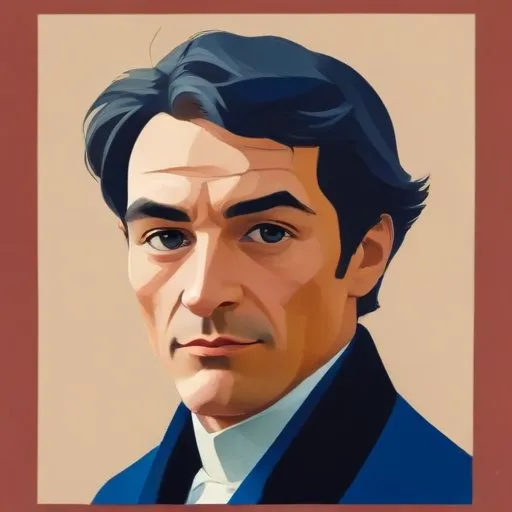
A Cubist painter who explored geometric forms and abstracted representations of reality, creating vibrant and dynamic works that pushed the boundaries of modern art.
Renowned for his innovative and avant-garde approach to art, Jacques Villon was a French Cubist and abstract painter who left an indelible mark on the art world. As a pioneer of the Cubist movement, Villon's work embodied a unique fusion of bold colors, geometric shapes, and abstract forms, which continue to inspire artists to this day.
Born Gaston Duchamp on July 31, 1875, in Damville, Eure, France, Villon came from a family of artists and was encouraged to explore his creative side from a young age. His maternal grandfather, Émile Frédéric Nicolle, a successful businessman and artist, played a significant role in nurturing Villon's artistic talents.
In 1894, Villon moved to Montmartre, Paris, where he began to study law at the University of Paris. However, his passion for art soon took precedence, and he adopted the pseudonym Jacques Villon as a tribute to the French medieval poet François Villon. This marked the beginning of his artistic career, during which he contributed cartoons and illustrations to Parisian newspapers, including the satirical weekly Le Courrier français.
Villon's early work was influenced by Edgar Degas and Henri de Toulouse-Lautrec, but he soon began to experiment with Fauvism, Cubism, and abstract impressionism. In 1903, he helped organize the drawing section of the first Salon d'Automne in Paris, and in 1904-1905, he studied art at the Académie Julian.
In 1906, Villon moved to Puteaux, a quiet suburb of Paris, where he began to focus on drypoint, an intaglio technique that creates dark, velvety lines. This marked a significant shift in his artistic style, as he began to explore the abstract and the unknown.
Villon's artistic contributions were multifaceted and far-reaching. He created only seven advertising posters in his career, which showcased his unique blend of Art Nouveau and Belle Époque styles. His distinctive drypoint prints, characterized by bold lines and abstract forms, continue to inspire artists and collectors alike.
Villon's work was also instrumental in shaping the Cubist movement, alongside artists like Pablo Picasso and Georges Braque. His innovative approach to art paved the way for future generations of artists, including the Surrealists and Abstract Expressionists.
Today, Jacques Villon is revered as a pioneering figure in modern art. His work can be found in museums and private collections around the world, including the Musée d'Orsay, the Metropolitan Museum of Art, and the Tate Modern.
Villon's impact on modern art is undeniable. He challenged conventional norms and pushed the boundaries of artistic expression, inspiring generations of artists to experiment and innovate. As a true original, Jacques Villon remains an enduring figure in the world of art.
Through his innovative and avant-garde approach to art, Jacques Villon left an indelible mark on the art world. His pioneering spirit and artistic genius continue to inspire and influence artists to this day.
Born in 1881
A pioneering artist who transformed modern art with pioneering Cubist works, creating a new visual language that continues to inspire and influence art, design, and culture.
Born in 1869
A pioneering artist who revolutionized modern art with bold, expressive, and colorful works that blurred the lines between painting and sculpture, creating a new language of form and color.
Born in 1882
A pioneer of Cubism, creating fragmented forms and multiple perspectives in art, revolutionizing modern art movements.
Born in 1904
A renowned surrealist master of bizarre, dream-like paintings and sculptures that blur reality and fantasy, known for iconic works like "The Persistence of Memory" and "The Elephants".
Born in 1898
A Belgian surrealist painter who challenged perceptions by depicting everyday objects in unexpected contexts, creating thought-provoking and witty visual paradoxes.
Born in 1893
A renowned Spanish artist, famous for his vibrant, dreamlike paintings and sculptures that blended abstraction and surrealism, creating a unique visual language. His works often featured bold colors, biomorphic forms, and a sense of playfulness.
Born in 1887
A dreamlike painter and poet who blended fantasy and reality, creating vibrant, emotive works that explored Jewish culture and the human experience.
Born in 1884
An Italian artist famous for elongated, emotive portraits and nudes that blended primitivism with cubism, capturing the essence of his subjects with expressive simplicity.
