


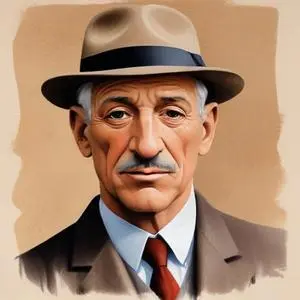
A pioneer of Cubism, creating fragmented forms and multiple perspectives in art, revolutionizing modern art movements.
Georges Braque, a renowned French painter, collagist, draughtsman, printmaker, and sculptor, is celebrated for his groundbreaking contributions to the development of Cubism, a radical art movement that transformed the landscape of modern art.
Born on May 13, 1882, in Argenteuil, Val-d'Oise, Braque grew up in Le Havre, where he trained as a house painter and decorator, following in the footsteps of his father and grandfather.
However, his passion for artistic painting led him to study at the École supérieure d'art et design Le Havre-Rouen, where he honed his skills between 1897 and 1899. Later, he apprenticed with a decorator in Paris, earning his certificate in 1902. The next year, he attended the Académie Humbert, where he met fellow artists Marie Laurencin and Francis Picabia.
Braque's initial works were impressionistic, but after discovering the Fauvist movement in 1905, he adopted their vibrant and expressive style. The Fauves, which included Henri Matisse and André Derain, sought to evoke emotions through bold colors.
In 1906, Braque traveled with fellow Fauvist Othon Friesz to L'Estaque, Antwerp, and Le Havre, where they developed a more subdued Fauvist style. In 1907, he successfully exhibited his Fauve works in the Salon des Indépendants, marking a pivotal moment in his career.
In 1908, Braque's style began to evolve, influenced by Paul Cézanne's work. This shift led to the development of Cubism, a revolutionary art movement that rejected traditional techniques of perspective and representation. Braque's work during this period, particularly between 1908 and 1912, is closely associated with that of his fellow Cubist, Pablo Picasso.
For many years, their respective Cubist works were indistinguishable, leading to a period of parallel creativity that would shape the course of modern art. Although Braque's introverted nature led to him being partially eclipsed by Picasso's fame, his contributions to Cubism are undeniable.
Braque's notable works include Violin and Pitcher (1910), Man with a Guitar (1911), and The Portuguese (1911). His artistic innovations continued beyond Cubism, as he explored other mediums, such as collage, sculpture, and printmaking.
Throughout his life, Braque was recognized for his artistic achievements, receiving numerous awards and honors. His work can be found in prominent museums worldwide, including the Musée National d'Art Moderne in Paris and the Museum of Modern Art in New York.
Braque's personal life was marked by a sense of introspection and simplicity. He married Marcelle Lapré, a French woman, in 1912, and they had a daughter, Mathilde, in 1913. During World War I, he served in the French Army, an experience that deeply affected him.
In his later years, Braque continued to paint, sculpt, and create prints, exploring new themes and techniques. He passed away on August 31, 1963, leaving behind a legacy that continues to inspire artists, designers, and art lovers around the world.
Braque's innovative spirit and artistic contributions have had a profound impact on modern art, influencing generations of artists, from Salvador Dalí to Ellsworth Kelly. His work continues to be celebrated for its beauty, complexity, and groundbreaking approach to representation.
In conclusion, Georges Braque's remarkable life and artistic achievements serve as a testament to the power of creativity and innovation, inspiring us to push boundaries and challenge the status quo.
Born in 1881
A pioneering artist who transformed modern art with pioneering Cubist works, creating a new visual language that continues to inspire and influence art, design, and culture.
Born in 1869
A pioneering artist who revolutionized modern art with bold, expressive, and colorful works that blurred the lines between painting and sculpture, creating a new language of form and color.
Born in 1904
A renowned surrealist master of bizarre, dream-like paintings and sculptures that blur reality and fantasy, known for iconic works like "The Persistence of Memory" and "The Elephants".
Born in 1893
A renowned Spanish artist, famous for his vibrant, dreamlike paintings and sculptures that blended abstraction and surrealism, creating a unique visual language. His works often featured bold colors, biomorphic forms, and a sense of playfulness.
Born in 1898
A Belgian surrealist painter who challenged perceptions by depicting everyday objects in unexpected contexts, creating thought-provoking and witty visual paradoxes.
Born in 1881
A pioneer of Cubism, this artist's bold, geometric works blended modernity with ancient forms, influencing generations of artists and designers.
Born in 1887
A dreamlike painter and poet who blended fantasy and reality, creating vibrant, emotive works that explored Jewish culture and the human experience.
Born in 1880
A pioneer of Fauvism, a style characterized by vivid colors and energetic brushstrokes, creating a new language of art that paved the way for modernist movements.
