


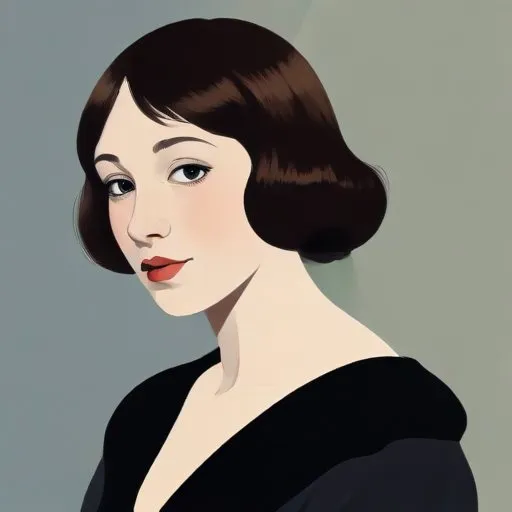
A French painter and illustrator renowned for her dreamy, ethereal portraits of women and children, often blending elements of Cubism and Fauvism. Her work exudes a sense of intimacy and quiet contemplation.
Marie Laurencin, a trailblazing French painter and printmaker, left an indelible mark on the Cubist movement, defying conventions with her ethereal, androgynous, and sublimely feminine art. As a muse, lover, and prominent figure in the Parisian avant-garde, Laurencin's unique style and liberated spirit continue to captivate art enthusiasts to this day.
Born on October 31, 1883, in Paris, France, Laurencin was raised by her mother and spent most of her life in the City of Light. At 18, she began studying porcelain painting in Sèvres, eventually returning to Paris to continue her artistic education at the Académie Humbert, where she shifted her focus to oil painting.
In the early 20th century, Laurencin became an integral part of the Parisian avant-garde, rubbing shoulders with luminaries like Pablo Picasso, Jean Metzinger, Albert Gleizes, Robert Delaunay, Henri le Fauconnier, and Francis Picabia. She exhibited her work alongside these influential artists at notable events like the Salon des Indépendants (1910-1911) and the Salon d'Automne (1911-1912), as well as the Galeries Dalmau in Barcelona, marking the first Cubist exhibition in Spain.
Laurencin's romantic involvement with the poet Guillaume Apollinaire not only inspired her art but also cemented her reputation as his muse. Additionally, she was a frequent visitor to the salon of American expatriate and lesbian writer Natalie Clifford Barney, where she forged connections with other artists and intellectuals. Her relationships with men and women, including her forty-year partnership with fashion designer Nicole Groult, greatly influenced her art, which often featured androgynous and feminine figures.
During World War I, Laurencin fled France for Spain with her German-born husband, Baron Otto von Watjen, after her marriage rendered her stateless. The couple briefly lived in Düsseldorf before divorcing in 1920, allowing Laurencin to return to Paris and regain her artistic momentum. Her exile, though tumultuous, had a profound impact on her work, which began to reflect her longing for the artistic hub of Paris.
Laurencin's distinctive style, characterized by delicate, elongated forms, and muted colors, defied the traditional norms of Cubism. Instead, she infused her art with a sense of elegance, lyricism, and whimsy, creating a unique brand of feminine Cubism. Her contributions to the movement continue to inspire artists, and her legacy extends beyond the art world, influencing fashion, literature, and queer culture.
Throughout her career, Laurencin received numerous accolades, including the prestigious Médaille d'Or at the 1925 Exposition Internationale des Arts Décoratifs et Industriels Modernes in Paris. Her work is now held in high esteem, with pieces displayed in prominent museums and private collections worldwide.
Marie Laurencin's life and art serve as a testament to the power of creativity, perseverance, and self-expression. As a pioneering female artist, she dared to challenge conventions, forging a unique path that continues to inspire and captivate audiences today. Her legacy extends far beyond the boundaries of Cubism, leaving an indelible mark on modern art, culture, and society as a whole.
Born in 1881
A pioneering artist who transformed modern art with pioneering Cubist works, creating a new visual language that continues to inspire and influence art, design, and culture.
Born in 1889
A renowned French creative force, celebrated for his innovative and surreal works that blurred the lines between literature, art, and cinema, leaving an indelible mark on 20th-century culture.
Born in 1879
A pioneering Dadaist and Surrealist, known for provocative, abstract artworks that challenged traditional representations of reality. His poetry and writings also explored the intersection of art and language.
Born in 1880
An Italian-French literary genius who pioneered Cubist poetry, blending fragmented images and multiple narratives to create a new kind of lyrical expression. His work influenced the development of Surrealism and modern art.
Born in 1880
A pioneer of Fauvism, a style characterized by vivid colors and energetic brushstrokes, creating a new language of art that paved the way for modernist movements.
Born in 1869
A pioneering artist who revolutionized modern art with bold, expressive, and colorful works that blurred the lines between painting and sculpture, creating a new language of form and color.
Born in 1877
A Fauvist painter and illustrator celebrated for vibrant, expressive works that captured the essence of modern life, from landscapes to still lifes, and even textiles and ceramics.
