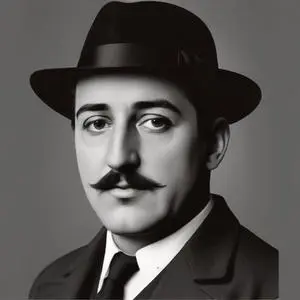
Guillaume Apollinaire

Guillaume Apollinaire

Guillaume Apollinaire was born on August 26th, 1880

Full Name: Guillaume Apollinaire
Place of Birth: Rome, Italy
Profession: Author, Poet, Playwright
Nationality: Italian-French
Notable Work: Alcools, Calligrammes
Education: Lycée Rollin, Paris
Literary Movement: Cubism, Surrealism
Death Year: 1918

An Italian-French literary genius who pioneered Cubist poetry, blending fragmented images and multiple narratives to create a new kind of lyrical expression. His work influenced the development of Surrealism and modern art.

Written by: Cassandra Blake Cassandra Blake

Guillaume Apollinaire: The Visionary Poet and Pioneer of Surrealism

A Life of Breaking Boundaries

Guillaume Apollinaire, a French poet, playwright, novelist, and art critic, is renowned for coining the terms "Cubism," "Orphism," and "Surrealism" to describe the emerging art movements of the early 20th century. His innovative works, characterized by a lack of punctuation, reflected his resolute commitment to modernity in both form and subject.

The Early Years: Influences and Inspirations

Born Wilhelm Albert Wodzimierz Apolinary Kostrowicki on August 26, 1880, Apollinaire was of Polish descent. During his youth, he was influenced by Symbolist poetry, which laid the foundation for his later experiments with language and form. His unique style, unbound by traditional conventions, earned him admiration from young poets who would eventually form the core of the Surrealist movement.

A Prolific Career: Literary and Artistic Contributions

Apollinaire's literary output was remarkable, with notable works including: As an art critic, Apollinaire wrote for various publications, including Le Matin, L'Intransigeant, and Paris Journal. In 1912, he co-founded Les Soirées de Paris, an artistic and literary magazine that became a hub for avant-garde creatives.

A Life of Controversy and Tragedy

Apollinaire's life was marked by controversy and tragedy. During World War I, he served in the French army and was wounded in 1916. Two years later, he died on November 9, 1918, during the Spanish flu pandemic. He was recognized as "Mort pour la France" (Fallen for France) due to his commitment during the war.

A Lasting Legacy

Despite his tragic demise, Apollinaire's influence on modern literature and art is immeasurable. His innovative spirit, embodied in his works, continues to inspire generations of writers, artists, and thinkers. As a pioneer of Surrealism, Apollinaire's legacy extends beyond the literary world, shaping the course of modern art, music, and culture.

Through his life and works, Guillaume Apollinaire remains an enigmatic figure, whose creative genius continues to captivate and inspire us to this day.

Timeline
1880
Born in Rome, Italy
Guillaume Apollinaire was born in Rome, Italy, to a Polish mother and an Italian father. He would go on to become a celebrated poet, playwright, and critic.
1902
Publishes First Poetry Collection
Apollinaire published his first collection of poetry, Lenchanteur pourrissant, which showcased his unique style and sensibility.
1912
Co-founds Cubist Movement
Apollinaire co-founded the Cubist movement alongside artists Pablo Picasso and Georges Braque, revolutionizing modern art.
1918
Dies at 38 from Spanish Flu
Apollinaire died on November 9, 1918, at the age of 38, a victim of the Spanish Flu pandemic that swept through Europe.
1918
Publishes Calligrammes
Apollinaires collection of poetry, Calligrammes, was published posthumously, cementing his legacy as a leading figure of modernist poetry.
Guillaume Apollinaire

Guillaume Apollinaire Quiz

What literary movement did Guillaume Apollinaire's work influence?

Score: 0/5
FAQ
What is Guillaume Apollinaires most famous literary work?
Guillaume Apollinaire is best known for his poetry collection Alcools, which is considered a seminal work of modernist poetry.
What was Guillaume Apollinaires role in the Cubist movement?
Guillaume Apollinaire was a friend and supporter of the Cubist artists, including Pablo Picasso and Georges Braque. He wrote about their work and helped to promote their ideas.
How did Guillaume Apollinaires experiences in World War I influence his writing?
Guillaume Apollinaires experiences in World War I had a profound impact on his writing, which often explored themes of violence, disillusionment, and the fragmentation of modern life.
What was Guillaume Apollinaires legacy in French literature?
Guillaume Apollinaires legacy in French literature is that of a poet, playwright, and critic who pushed the boundaries of language and form.
What is the significance of Guillaume Apollinaires writings on art?
Guillaume Apollinaires writings on art are significant because they helped to establish Cubism as a major art movement and influenced the development of modern art criticism.

Related People:

Pablo Picasso

Born in 1881

A pioneering artist who transformed modern art with pioneering Cubist works, creating a new visual language that continues to inspire and influence art, design, and culture.

Henri Matisse

Born in 1869

A pioneering artist who revolutionized modern art with bold, expressive, and colorful works that blurred the lines between painting and sculpture, creating a new language of form and color.

Jean Cocteau

Born in 1889

A renowned French creative force, celebrated for his innovative and surreal works that blurred the lines between literature, art, and cinema, leaving an indelible mark on 20th-century culture.

Sergei Diaghilev

Born in 1872

A visionary who revolutionized ballet by combining avant-garde music, art, and dance, creating a new era of modern ballet. His company showcased works by renowned artists like Stravinsky and Picasso.

Marcel Duchamp

Born in 1887

A pioneering artist who challenged conventional norms by submitting a urinal as art, sparking a revolution in conceptual art and questioning the very definition of art itself.

André Breton

Born in 1896

French poet and author who founded Surrealism, a cultural movement that explored the subconscious and the world of dreams. He wrote novels, poems, and essays that continue to influence art and literature today.

Louis Aragon

Born in 1897

A leading figure of the French Resistance during WWII, he wrote influential poetry and novels that explored the human condition, blending politics and art.

Salvador Dalí

Born in 1904

A renowned surrealist master of bizarre, dream-like paintings and sculptures that blur reality and fantasy, known for iconic works like "The Persistence of Memory" and "The Elephants".