


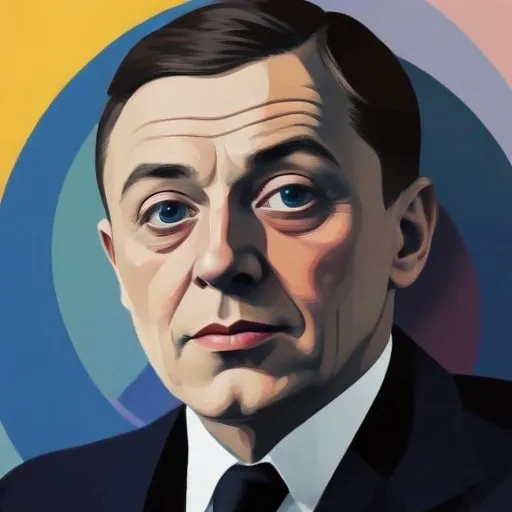
A pioneer of Orphism, a style of abstract art that emphasizes geometric shapes and vibrant colors, creating dynamic and expressive works that explore the emotional potential of color. 42
Robert Delaunay, a renowned French artist, is best known for co-founding the Orphism art movement with his wife Sonia Delaunay and others, characterized by its bold use of geometric shapes and vibrant colors. His innovative approach to art, which emphasized the emotional and expressive qualities of color, had a profound impact on the development of modern art.
Born on April 12, 1885, in Paris, France, Delaunay was raised in a family of modest means. Despite the financial constraints, his parents encouraged his artistic inclinations from an early age. He began his artistic training at the age of 12 and later attended the Académie de Montmartre.
In the early 1910s, Delaunay, along with his wife Sonia, and other artists, founded the Orphism movement. This art movement was characterized by its use of geometric shapes, vibrant colors, and a focus on the emotional and expressive qualities of art. Delaunay's theories on color, which emphasized its ability to evoke emotions and create a sense of movement, were instrumental in shaping the movement.
Delaunay's artistic innovations didn't stop at Orphism. He developed several techniques that allowed him to create a sense of depth and movement in his paintings. One of his most notable techniques was the use of "simultaneous contrasts," where he would juxtapose colors with their complementary hues to create a sense of tension and energy.
His theories on color were also groundbreaking. Delaunay believed that color was a thing in itself, with its own powers of expression and form. He argued that color could evoke emotions, create a sense of movement, and even impact our perception of reality.
Delaunay's body of work includes several notable series, each showcasing his innovative techniques and theories. Some of his most famous series include:
Delaunay's impact on modern art is immeasurable. His innovative techniques, theories on color, and Orphism movement paved the way for a range of art movements, including Fauvism, Cubism, and Abstract art. Artists such as Stanton Macdonald-Wright, Morgan Russell, Patrick Henry Bruce, and Lyonel Feininger, among many others, were influenced by Delaunay's work.
Delaunay's legacy extends beyond the art world. His emphasis on the emotional and expressive qualities of color has inspired designers, architects, and musicians to explore the power of color in their respective fields.
Delaunay's personal life was marked by tragedy. His marriage to Sonia Delaunay, a talented artist in her own right, was a strong partnership that endured for over three decades. However, the couple's son, Charles, died in 1927, leaving them heartbroken.
In his later years, Delaunay continued to paint, although his output slowed significantly. He passed away on October 25, 1941, leaving behind a legacy that continues to inspire and influence artists to this day.
Born in 1869
A pioneering artist who revolutionized modern art with bold, expressive, and colorful works that blurred the lines between painting and sculpture, creating a new language of form and color.
Born in 1881
A pioneering artist who transformed modern art with pioneering Cubist works, creating a new visual language that continues to inspire and influence art, design, and culture.
Born in 1881
A pioneer of Cubism, this artist's bold, geometric works blended modernity with ancient forms, influencing generations of artists and designers.
Born in 1887
A pioneer of Cubism, creating innovative, geometrically fragmented artworks that blurred the lines between representation and abstraction. His unique style continues to inspire artists and art enthusiasts alike.
Born in 1881
A French painter who pioneered Cubism, creating abstract, geometric works that rejected traditional techniques and paved the way for modern art movements.
Born in 1883
A pioneering Futurist painter and writer, known for vibrant, dynamic works that captured the energy of modern life and the chaos of war.
Born in 1871
A German-American painter and illustrator who blended cubism and futurism to create vibrant, abstracted cityscapes and seascapes, influencing the development of modern art.
