


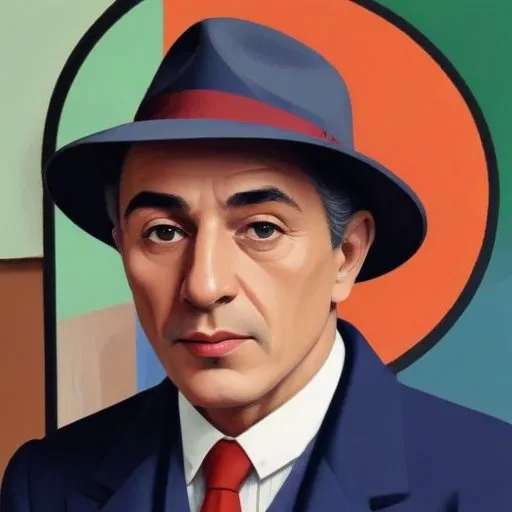
A pioneering Futurist painter and writer, known for vibrant, dynamic works that captured the energy of modern life and the chaos of war.
Gino Severini, an Italian painter, is renowned for his pioneering contributions to the Futurist movement, an avant-garde art movement that emerged in the early 20th century. As a leading figure in Futurism, Severini's work embodied the ideals of dynamism, energy, and modernity, which continue to inspire artists and art enthusiasts to this day.
Born on April 7, 1883, in Cortona, Italy, Severini grew up in a poor family where his father was a junior court official and his mother a dressmaker. Despite the challenges, Severini's artistic talent was evident from an early age. After being expelled from the Italian school system at 15, he worked with his father and later moved to Rome with his mother, where he developed a passion for art.
Severini's artistic journey began in earnest when he met Umberto Boccioni, a fellow painter, in 1900. Together, they visited the studio of Giacomo Balla, where they were introduced to the technique of Divisionism, a style that emphasized breaking down colors into stippled dots and stripes. This encounter had a profound impact on Severini's early work and eventually influenced Futurist painting.
In 1906, Severini settled in Paris, a city that would become his home for many years. This move marked a turning point in his career, as he became part of a vibrant artistic community that included Henri Matisse, Pablo Picasso, and Amedeo Modigliani. It was during this period that Severini developed his signature style, characterized by bold colors, dynamic forms, and a sense of movement.
In the years leading up to World War I, Severini's work became increasingly associated with Futurism, a movement that sought to revolutionize art and challenge traditional norms. His paintings, such as Armored Train in Action (1915) and Dynamism of a Dog on a Leash (1912), exemplified the Futurist ideals of speed, energy, and mechanical power.
In the aftermath of World War I, Severini's style underwent a significant transformation. He began to explore neoclassicism, a movement that sought to revive classical ideals and promote a return to order. This shift was reflected in his paintings, such as The Dancer (1919), which featured more harmonious colors, classic poses, and a sense of serenity.
During this period, Severini's work also became more diverse, incorporating techniques such as mosaic and fresco. He exhibited his work at major exhibitions, including the Rome Quadrennial, and received numerous art prizes from prestigious institutions.
Gino Severini's contributions to modern art are undeniable. As a leading figure in Futurism, he played a crucial role in shaping the movement's aesthetic and ideology. His work continues to inspire artists, designers, and architects, and his legacy extends beyond the art world, influencing popular culture, fashion, and architecture.
Through his art, Severini reminds us of the importance of innovation, experimentation, and pushing boundaries. As we navigate the complexities of the 21st century, Severini's work serves as a testament to the power of creativity and the human spirit.
Born in 1882
A pioneering figure in Futurism, creating dynamic, abstracted depictions of modern life and technology, blending sculpture and painting to capture the essence of speed and energy.
Born in 1871
A pioneering Futurist artist, capturing dynamic movement and energy in vibrant, abstracted paintings that blur the lines between art and technology.
Born in 1883
An Italian avant-garde artist who pioneered noise music and created innovative instruments to produce industrial sounds, influencing the development of 20th-century music.
Born in 1881
A 20th-century Italian painter, known for his abstract and lyrical works that explored the relationship between color and emotion. His vibrant, expressive paintings continue to inspire artists and art lovers alike.
Born in 1888
A pioneer of Surrealist art, creating dreamlike, eerie, and thought-provoking scenes that blend reality and fantasy, influencing generations of artists and filmmakers.
Born in 1884
An Italian artist famous for elongated, emotive portraits and nudes that blended primitivism with cubism, capturing the essence of his subjects with expressive simplicity.
Born in 1881
A pioneer of Cubism, this artist's bold, geometric works blended modernity with ancient forms, influencing generations of artists and designers.
Born in 1881
A pioneering artist who transformed modern art with pioneering Cubist works, creating a new visual language that continues to inspire and influence art, design, and culture.
