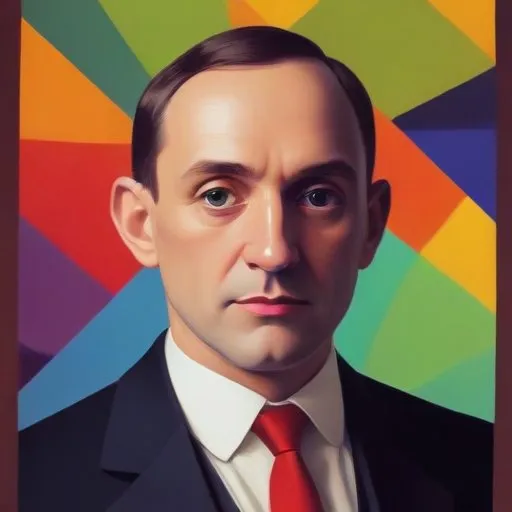
Stanton Macdonald-Wright: The Pioneer of Synchromism
A Colorful Journey of Abstraction and Innovation
Stanton Macdonald-Wright, a visionary American artist, is renowned for co-founding Synchromism, an avant-garde art movement that revolutionized the world of abstract art. Born on July 8, 1890, in Charlottesville, Virginia, Macdonald-Wright's artistic trajectory was marked by innovation, experimentation, and a passion for color.
Early Life and Influences
Growing up in Santa Monica, California, Macdonald-Wright's father, a businessman and amateur artist, encouraged his artistic development from a young age. He received private painting lessons, which laid the foundation for his future endeavors. His older brother, Willard Huntington Wright, a writer and critic, also played a significant role in shaping Macdonald-Wright's creative vision.
Synchromism: A Harmonious Union of Color and Music
Macdonald-Wright's artistic journey took a significant turn when he moved to Paris with his wife, where he immersed himself in European art and studied at various prestigious institutions, including the Sorbonne, Académie Julian, École des Beaux-Arts, and Académie Colarossi. It was during this period that he collaborated with fellow student Morgan Russell, under the guidance of Canadian painter Percyval Tudor-Hart. Together, they developed Synchromism, an art movement that sought to liberate art from literal descriptions and merge painting with music.
The Art of Synchromism
Synchromism, which translates to "with color," was a unique approach that focused on the emotional and psychological effects of color. Macdonald-Wright and Russell believed that art should be divorced from representational associations and instead, evoke emotions and sensations akin to music. Their innovative use of color, characterized by bold juxtapositions and reverberations, paved the way for future abstract art movements.
A Life of Artistic Expression
Throughout his career, Macdonald-Wright continued to push the boundaries of art, experimenting with various techniques and mediums. His work was showcased in numerous exhibitions, garnering attention from both American and European art circles. In addition to his artistic pursuits, Macdonald-Wright was an accomplished writer, publishing several articles and books on art theory and criticism.
Legacy and Impact
Stanton Macdonald-Wright's pioneering work in Synchromism has had a profound impact on the development of modern art. His innovative approach to color and abstraction has inspired generations of artists, from the Abstract Expressionists to contemporary artists. Today, his work is held in high esteem, with many of his pieces forming part of esteemed museum collections, including the Metropolitan Museum of Art and the Los Angeles County Museum of Art.
Personal Milestones and Key Life Events
- 1890: Born in Charlottesville, Virginia
- 1907: Moved to Paris to study art
- 1911: Developed Synchromism with Morgan Russell
- 1920s: Published articles and books on art theory and criticism
- 1973: Passed away on August 22
Quotes and Memorable Sayings
"The artist's problem is to realize his conception, not to represent the thing." - Stanton Macdonald-Wright
Comparative Analysis with Contemporaries
Macdonald-Wright's work can be juxtaposed with that of his contemporaries, such as the Fauvists and Cubists, who were also experimenting with color and form. However, Synchromism's unique focus on the emotional and psychological effects of color sets it apart from other early 20th-century art movements.
FAQ
What is Stanton Macdonald-Wrights artistic style?
Stanton Macdonald-Wrights artistic style is characterized by his use of vibrant colors, geometric shapes, and abstract forms. He was a pioneer of the Synchromist movement, which emphasized the use of color and music in art.
What is Synchromism in art?
Synchromism is an art movement that emerged in the early 20th century, characterized by the use of color, music, and abstract forms. It was founded by Stanton Macdonald-Wright and Morgan Russell, and aimed to create a new language of art that would evoke emotions and express the rhythm of modern life.
What is Stanton Macdonald-Wrights most famous work?
Stanton Macdonald-Wrights most famous work is his painting Synchromy in Orange: To Form (1914), which is considered a masterpiece of the Synchromist movement. The painting features abstract forms and vibrant colors, and is characterized by its sense of energy and movement.
Who influenced Stanton Macdonald-Wrights artistic style?
Stanton Macdonald-Wrights artistic style was influenced by the works of Henri Matisse, Pablo Picasso, and other European modernists. He was also influenced by the ideas of music and color theory.
What is Stanton Macdonald-Wrights legacy in the art world?
Stanton Macdonald-Wrights legacy in the art world is significant, as he was a pioneer of the Synchromist movement and a leading figure in the development of modern American art. His work continues to inspire artists and art historians today