


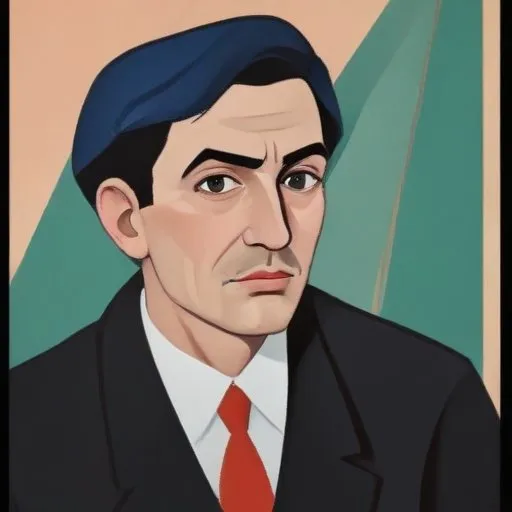
A French painter who pioneered Cubism, creating abstract, geometric works that rejected traditional techniques and paved the way for modern art movements.
Albert Gleizes, a French artist, theoretician, and philosopher, is renowned for being a self-proclaimed founder of Cubism, a pioneering art movement of the early 20th century. Alongside Jean Metzinger, Gleizes co-authored the seminal treatise, Du Cubisme, in 1912, which provided a foundational framework for understanding the principles and practices of Cubism.
Gleizes' theoretical writings, which were highly regarded in Germany, particularly at the Bauhaus, significantly influenced the development of modern art. His ideas were instrumental in shaping the aesthetic and philosophical underpinnings of modernism, as evidenced by the numerous art movements that emerged in its wake, including Futurism, Surrealism, and Abstract Art.
Born Albert Léon Gleizes on December 8, 1881, in Paris, France, he was the son of a fabric designer and the nephew of Léon Comerre, a successful portrait painter. Gleizes' early life was marked by a disdain for formal education, which he often skipped to pursue his passion for poetry and wandering through the Montmartre cemetery.
After completing his secondary schooling, Gleizes spent four years in the 72nd Infantry Regiment of the French army in Abbeville, Picardie, before devoting himself to a career as a painter. Initially, he was self-taught and worked in the Impressionist tradition, but his artistic style soon evolved to encompass the principles of Cubism.
Gleizes' contributions to the development of modern art and his influence on the trajectory of art historical narratives are undeniable. His theoretical writings and artistic practices have inspired generations of artists, art critics, and historians. Today, Gleizes is recognized as a pivotal figure in the history of modern art, and his work continues to be celebrated and studied worldwide.
Gleizes spent four crucial years in New York, where he played a significant role in introducing modern art to America. During this period, he was an active member of the art community, participating in various exhibitions and events. Gleizes passed away on June 23, 1953, leaving behind a rich legacy of artistic innovation and theoreticalcontributions that continue to shape the discourse of modern art.
Born in 1881
A pioneering artist who transformed modern art with pioneering Cubist works, creating a new visual language that continues to inspire and influence art, design, and culture.
Born in 1869
A pioneering artist who revolutionized modern art with bold, expressive, and colorful works that blurred the lines between painting and sculpture, creating a new language of form and color.
Born in 1883
A Cubist painter who blended geometric shapes and vibrant colors to create dynamic, fragmented forms, influencing the development of modern art.
Born in 1885
A pioneer of Orphism, a style of abstract art that emphasizes geometric shapes and vibrant colors, creating dynamic and expressive works that explore the emotional potential of color. 42
Born in 1881
A pioneer of Cubism, this artist's bold, geometric works blended modernity with ancient forms, influencing generations of artists and designers.
Born in 1880
An Italian-French literary genius who pioneered Cubist poetry, blending fragmented images and multiple narratives to create a new kind of lyrical expression. His work influenced the development of Surrealism and modern art.
Born in 1887
A pioneering artist who challenged conventional norms by submitting a urinal as art, sparking a revolution in conceptual art and questioning the very definition of art itself.
Born in 1878
A Ukrainian painter and theorist who founded the Suprematist movement, creating geometric abstract works that explored the emotional and spiritual properties of color. They're most known for their iconic "Black Square" painting.
