


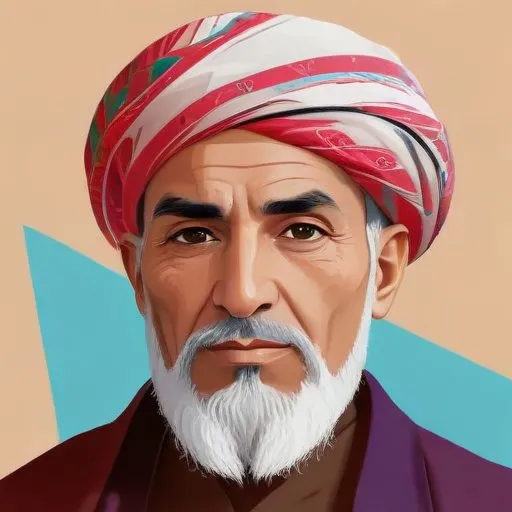
The founder of the Barakzai dynasty, who unified Afghanistan and resisted British colonialism, establishing the country's modern borders and earning the title "Father of Modern Afghanistan".
As the founder of the Barakzai dynasty, Dost Mohammad Khan is renowned for unifying the fragmented principalities of Afghanistan and steering the country through the tumultuous years of the First Anglo-Afghan War. His 36-year reign, which began in 1826, is a testament to his astute leadership and vision for a united Afghanistan.
Born on December 23, 1792, in Kandahar, Dost Mohammad Khan was the 11th son of Payinda Khan, the chief of the Barakzai Pashtuns. His family, tracing its roots back to Abdal, the founder of the Abdali tribe, was known for its influential position in the Durrani Empire.
Following the decline of the Durrani dynasty, Dost Mohammad Khan's brother, Fateh Khan, played a pivotal role in installing Mahmud Shah Durrani as the sovereign of Afghanistan in 1800. After Fateh Khan's death, Dost Mohammad Khan seized the opportunity to assert his own claim to power, eventually becoming the Emir of Afghanistan in 1826.
Dost Mohammad Khan's early reign was marked by military campaigns to consolidate his power and expand his territories. In 1823, he lost the Peshawar Valley to the Sikh Khalsa Army of Ranjit Singh at the Battle of Nowshera. However, he later reunited the principalities of Kandahar and Herat with Kabul, solidifying his position as a powerful ruler.
The First Anglo-Afghan War, which lasted from 1839 to 1842, was a defining period in Dost Mohammad Khan's reign. Despite the British forces' superior military might, Dost Mohammad Khan's strategic prowess and guerrilla warfare tactics allowed him to resist their occupation. Although he was eventually forced to flee, his bravery and determination earned him the respect of his people and the British alike.
Dost Mohammad Khan's legacy is profound and far-reaching. He established the Barakzai dynasty, which ruled Afghanistan for over a century, and paved the way for modern Afghanistan's formation. His vision for a united and independent Afghanistan continues to inspire generations of Afghans.
Aside from his military campaigns and political achievements, Dost Mohammad Khan was a patron of arts and culture. He spoke multiple languages, including Pashto, Persian, Punjabi, Turkish, and Kashmiri, and encouraged scholars and poets to flourish in his court.
Dost Mohammad Khan's personal life was marked by family ties and alliances. He married multiple times and had several children, many of whom went on to play important roles in Afghan politics. His family, the Musahiban family, continued to wield significant influence in Afghan politics well into the 20th century.
In conclusion, Dost Mohammad Khan's remarkable life and achievements have left an indelible mark on Afghan history. As a visionary leader, military strategist, and patron of arts and culture, he continues to inspire and influence generations of Afghans and beyond.
Born in 1892
Reformer and modernizer who introduced Western-style reforms and gained independence from British colonial rule, transforming Afghanistan into a modern nation-state.
68 Years Old
The first democratically elected president of Afghanistan, leading the country from 2004 to 2014 and playing a key role in rebuilding the nation after decades of war. He's known for his efforts to establish a stable government and promote national unity.
