


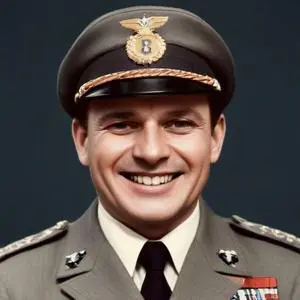
A British Royal Air Force flying ace during World War II, known for his bravery and flying skills despite having two prosthetic legs. He was a symbol of inspiration and determination.
Douglas Bader, a Royal Air Force (RAF) flying ace, defied all odds by taking to the skies again after losing both his legs in a plane crash. Credited with 22 aerial victories, four shared victories, and six probables, Bader's unwavering determination and unrelenting spirit made him a legend in the world of military aviation.
Born on February 21, 1910, Douglas Robert Steuart Bader was raised in London, England. He developed a passion for flying at a young age and joined the RAF in 1928, earning his commission in 1930. Tragedy struck in December 1931, when Bader crashed while attempting aerobatics, resulting in the loss of both his legs.
Against all medical odds, Bader recovered and underwent intensive rehabilitation. He retook flight training, passed his check flights, and requested reactivation as a pilot. However, he was retired against his will on medical grounds due to the lack of regulations applicable to his situation.
With the outbreak of World War II in 1939, Bader's determination paid off, and he was accepted back into the RAF as a pilot. He scored his first victories over Dunkirk during the Battle of France in 1940 and went on to participate in the Battle of Britain, where he earned a reputation as a skilled and fearless pilot. His friendship with Air Vice Marshal Trafford Leigh-Mallory and support for his Big Wing experiments further cemented his position as a respected figure in the RAF.
In August 1941, Bader baled out over German-occupied France and was captured. He met and befriended Adolf Galland, a prominent German fighter ace, during his captivity. Despite his disability, Bader made several escape attempts, earning him a reputation as a troublesome prisoner. He was eventually sent to the prisoner-of-war camp at Colditz Castle, where he remained until April 1945, when the camp was liberated by the First United States Army.
After leaving the RAF permanently in February 1946, Bader resumed his career in the oil industry. His remarkable life story inspired the book and film "Reach for the Sky," which chronicled his life and RAF career up to the end of World War II. Bader became a vocal advocate for disabled people, and his tireless efforts earned him a Knighthood in 1976 for his services to the disabled community.
Douglas Bader continued to fly until ill health forced him to stop in 1979. He passed away on September 5, 1982, at the age of 72, following a heart attack. His remarkable story of resilience, determination, and courage has inspired countless individuals, cementing his place as one of the most iconic figures in military aviation history.
"Reach for the Sky" (1956) - a film adaptation of Bader's life story, starring Kenneth More as Douglas Bader.
"Fight for the Sky: The Story of Douglas Bader" (1985) - a biography by Paul Brickhill.
Born in 1871
Prolific writer of historical novels and adventure stories, also a talented landscape painter.
Born in 1900
The wife of King George VI and mother of Queen Elizabeth II, known for her strong support of the British people during World War II and her iconic sense of style.
Born in 1893
A high-ranking Nazi official, he was a decorated World War I fighter pilot and later became a prominent politician, serving as Minister President of Prussia. He's infamous for his role in the Nazi regime and war crimes trials.
Born in 1922
Highest-scoring fighter ace in the history of aerial warfare, credited with 352 aerial victories during World War II.
