


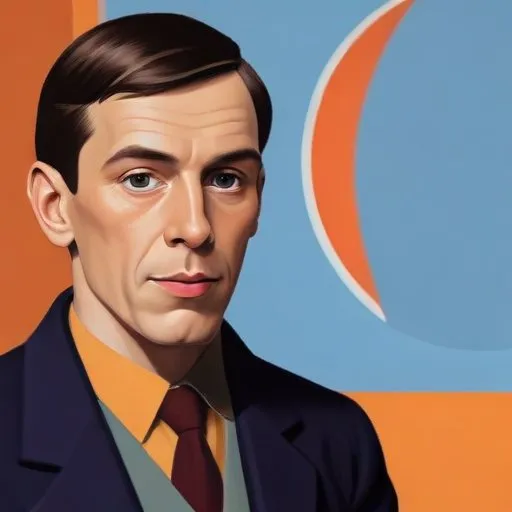
A British painter and designer who was a key figure in the Bloomsbury Group, creating vibrant, expressive works that blended modernism with traditional techniques. He's also known for his textile designs and decorative arts.
Duncan Grant, a Scottish painter and designer, was a central figure of the Bloomsbury Group, a coterie of innovative artists, writers, and intellectuals that revolutionized British art and literature in the early 20th century. As a master of multiple mediums, Grant's oeuvre encompasses textiles, pottery, theatre sets, and costumes, showcasing his boundless creativity and versatility.
Grant was born on January 21, 1885, in Rothiemurchus, Aviemore, Scotland, to Major Bartle Grant and Ethel Isabel McNeil. His early childhood was spent in India and Burma, where his family lived between 1887 and 1894, returning to England every two years. During this period, he was educated by his governess, Alice Bates, who instilled in him a love for art and culture.
In 1902, Grant was enrolled at Westminster School of Art, where he studied for three years under the guidance of Simon Bussy, a French painter and friend of Henri Matisse. This formative experience introduced Grant to the avant-garde movements of Europe, which would profoundly shape his artistic vision. Upon his return to London, Grant became an integral member of the Bloomsbury Group, befriending luminaries such as Virginia Woolf, E.M. Forster, and Lytton Strachey.
Grant's artistic repertoire expanded to include textiles, pottery, and theatre design, earning him recognition as a master craftsman. His work in these fields was characterized by a fusion of modernist sensibilities with a deep appreciation for traditional techniques. Grant's designs for the Omega Workshops, a pioneering design collective founded by Roger Fry, further cemented his reputation as a versatile artist.
Duncan Grant's remarkable career spans multiple artistic mediums, leaving an indelible mark on British modernism. His work continues to inspire artists, designers, and scholars, ensuring his legacy as a true Renaissance man of the 20th century.
"Art is not a mirror held up to reality, but a hammer with which to shape it."
Grant's work is held in high esteem by museums and collections worldwide, including the Tate Britain, the Victoria and Albert Museum, and the Scottish National Gallery of Modern Art. His contributions to the Bloomsbury Group's artistic output have secured his place in the annals of art history, influencing generations of artists to come.
As a testament to his enduring legacy, Grant's work remains a powerful symbol of the innovative spirit of the Bloomsbury Group, inspiring artists, designers, and scholars to push the boundaries of creativity and imagination.
Born in 1882
A pioneering author of modernist literature, known for experimental novels and essays that explored the human experience, blurring the lines between reality and fiction.
Born in 1879
This celebrated author crafted novels and plays that probed the human condition, exploring themes of social class, morality, and personal relationships, with a distinctive wit and insight. Their works continue to captivate audiences with their nuanced portrayals of English society during the early 20th century.
Born in 1880
A leading figure in the Bloomsbury Group, known for revolutionizing biography writing with witty, irreverent, and psychologically nuanced portraits of historical figures.
Born in 1866
A pioneering art critic and painter who introduced Post-Impressionism to Britain, promoting artists like Van Gogh and Gauguin through exhibitions and writings.
67 Years Old
A British radio host and presenter, best known for his work on BBC Radio 2 and BBC Radio London, entertaining audiences with his warm and engaging on-air personality.
Born in 1883
A pioneering economist who revolutionized modern economic theory with his groundbreaking ideas on government intervention and fiscal policy, shaping global economic policies.
