


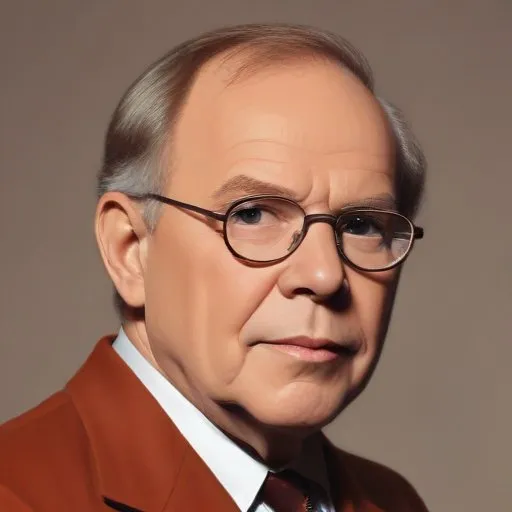
Pioneering composer of avant-garde and experimental music, known for introducing indeterminacy and improvisation into classical music, creating a new language of sound.
Earle Brown, a renowned American composer, is best known for establishing his own formal and notational systems, which have had a profound impact on the world of music. His groundbreaking work, particularly in open form, has influenced generations of composers, including the downtown New York scene of the 1980s, led by John Zorn.
Born on December 26, 1926, in Lunenburg, Massachusetts, Brown's early life was marked by a passion for jazz and a brief consideration of a career in engineering. He enrolled in Northeastern University in 1944-1945, but soon enlisted in the U.S. Air Force in 1945, where he played trumpet in the base band at Randolph Field, Texas.
Brown's most notable works include:
These innovative compositions have been widely performed and published, earning Brown recognition as a member of the New York School of composers, alongside John Cage, Morton Feldman, and Christian Wolff.
Brown's contact with John Cage led to his involvement in the Project for Music for Magnetic Tape in New York, where he worked as an editor and recording engineer for Capitol Records (1955-1960) and producer for Time-Mainstream Records (1960-1973). This exposure introduced his music to a broader audience, including prominent composers like Pierre Boulez and Bruno Maderna, who promoted his work.
In 1998, Brown was awarded the Foundation for Contemporary Arts John Cage Award, solidifying his position as a pioneering figure in modern music.
Brown's work was characterized by a focus on the visual aspects of music, often incorporating graphic scores and unconventional notation systems. This approach allowed for a greater degree of freedom and spontaneity in performance, reflecting his emphasis on the importance of the individual performer's interpretation.
Brown's philosophy is encapsulated in his quote, "The "work" is not the score, but the realization of the score."
Earle Brown's trailblazing work has inspired numerous composers, musicians, and artists across various genres. His influence can be seen in the experimental and avant-garde movements of the 1960s and 1970s, as well as in contemporary music and art.
By challenging traditional notions of musical notation and performance, Brown has left an indelible mark on the world of music, ensuring his legacy as a true innovator and visionary.
Brown's personal life was marked by a love for jazz and a close friendship with saxophonist Zoot Sims, with whom he played in the U.S. Air Force band. His connection with John Cage not only influenced his music but also introduced him to prominent figures in the avant-garde scene.
84 Years Old
A visionary musician and producer who co-founded The Velvet Underground, pushing boundaries in rock music and influencing generations of artists. Known for experimental and avant-garde work .
Born in 1926
A pioneer of indeterminacy in music, creating subtle, atmospheric soundscapes that defy traditional composition, and teaching generations of musicians to think outside the box.
Born in 1679
Developed a philosophical system that combined elements of Leibniz and Descartes, and was a prominent figure in the German Enlightenment. He wrote extensively on metaphysics, ethics, and logic.
Born in 1925
A renowned French musician who revolutionized classical music with his avant-garde compositions and innovative conducting style, pushing boundaries and redefining the genre.
98 Years Old
A pioneer of electronic and avant-garde music, this composer pushed boundaries with unconventional sounds and performances, influencing generations of musicians and artists.
Born in 1925
An Italian maestro who blended classical and avant-garde styles, creating innovative compositions that pushed musical boundaries. He's renowned for his bold, eclectic works that challenged traditional conventions.
Born in 1923
A visionary composer and educator who pushed the boundaries of classical music with his avant-garde and innovative works, blending dissonance and harmony in unique ways.
Born in 1908
A pioneering composer of modern classical music, known for his complex and innovative works that pushed the boundaries of harmony and rhythm.
