


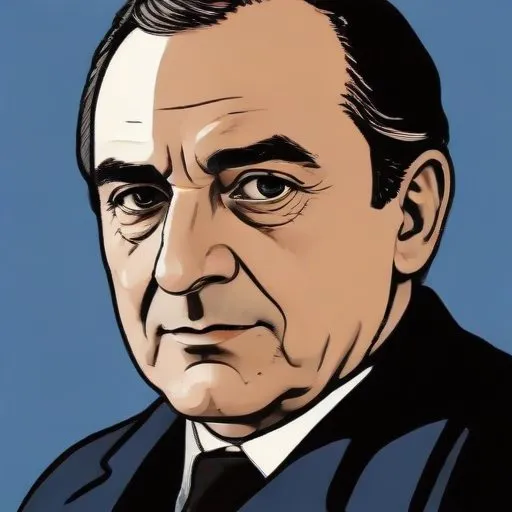
A French historian and politician who served as Prime Minister of France, known for his efforts to reform the country's education system and his role in shaping France's post-war identity.
Edgar Faure, a renowned French politician, lawyer, essayist, and historian, served as Prime Minister of France twice, in 1952 and from 1955 to 1956. He was a prominent figure in French politics, particularly during the Fourth Republic, and left an indelible mark on the country's history.
Faure was born on August 18, 1908, in Béziers, Hérault, to a French Army doctor. Despite being nearsighted, he excelled academically, earning a baccalauréat at 15 and a law degree at 19 in Paris. He became a member of the bar association at 21, the youngest lawyer in France at the time.
Faure's entry into politics began in 1929 when he joined the Radical Party. During World War II, he joined the French Resistance and later fled to Algiers, where he worked with Charles de Gaulle's headquarters. After the war, he served as French counsel for the prosecution at the Nuremberg Trials.
In 1946, he was elected to the French Parliament as a Radical and went on to lead the cabinet in 1952 and from 1955 to 1956. Faure played a crucial role in the formation of governments, as his party often held a disproportionate amount of power despite its declining popularity.
Faure's political career was marked by his leadership of the more conservative wing of the Radical Party, opposing the party's left wing under Pierre Mendès France. He initially opposed the Fifth Republic but eventually became a Gaullist.
His legacy extends beyond politics. In 1978, he was elected to the Académie Française, a prestigious institution dedicated to the preservation and promotion of the French language.
Faure was married to writer Lucie Meyer, and his personal relationships were marked by his commitment to public service and his country.
Faure's contributions to French history and politics are undeniable. He played a crucial role in shaping the country's post-war landscape and left an indelible mark on its political and cultural institutions.
Through his writing and public service, Faure inspired generations of French citizens and politicians, cementing his place as one of the most important figures in modern French history.
Born in 1890
A French military leader who led the Free French Forces during WWII and later became President of France, known for his strong leadership and vision for a unified Europe.
Born in 1916
A French lawyer and politician who served as the 21st President of France, known for his socialist policies and role in shaping the European Union. He's also remembered for his controversial past and complex personality.
Born in 1911
A French banker-turned-politician who served as President of France from 1969 to 1974, known for modernizing the country's economy and infrastructure. He's also famous for commissioning the iconic Pompidou Center in Paris.
93 Years Old
A French military officer and statesman who served as President of France from 1995 to 2007, known for his opposition to the US-led invasion of Iraq and his efforts to strengthen the European Union.
71 Years Old
The 23rd President of France, a lawyer-turned-politician who led the country from 2007 to 2012, known for his efforts to reform the EU and his controversial domestic policies.
72 Years Old
The 24th President of France, a key European leader who implemented significant economic reforms and played a crucial role in shaping the European Union's policies, particularly during the European sovereign-debt crisis.
48 Years Old
The 25th President of France is a centrist leader who has been a driving force behind the European Union and a strong advocate for climate action. He has implemented various reforms to modernize the French economy and has been a key player in international diplomacy.
96 Years Old
French politician who served as Prime Minister of France from 1988 to 1991, known for his efforts to reform the country's economy and social policies.
