


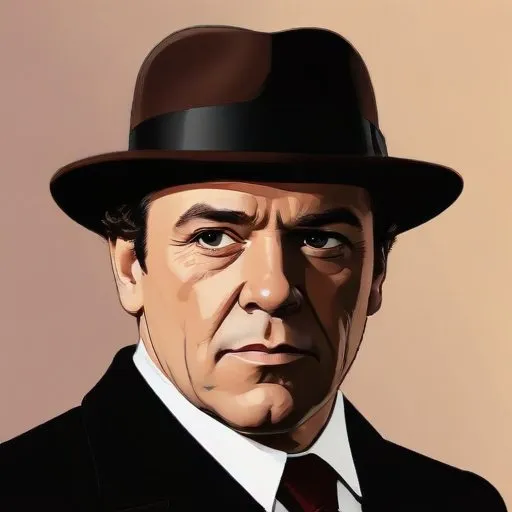
A talented actor who brought depth and nuance to a wide range of film noir and drama roles, earning him numerous awards and nominations.
Edmond O'Brien was an American actor of stage, screen, and television, and film director, known for his versatile performances in a wide range of genres, from drama to comedy, and from film noir to science fiction. With a career spanning almost 40 years, O'Brien won numerous awards, including one Academy Award, two Golden Globe Awards, and two stars on the Hollywood Walk of Fame.
O'Brien was born on September 10, 1915, in Brooklyn, New York, to Agnes and James O'Brien, both natives of Tallow, County Waterford, Ireland. After his father's death when he was just four years old, O'Brien developed an interest in magic and performing, and began acting in plays at school. He attended Fordham University for six months before winning a scholarship to the Neighborhood Playhouse School of the Theatre, where he studied under renowned teachers Sanford Meisner and others.
O'Brien's breakthrough role came in 1939 with his portrayal of the Gringoire in The Hunchback of Notre Dame, opposite Charles Laughton. This marked the beginning of a successful career in Hollywood, with notable films such as The Killers (1946), A Double Life (1947), White Heat (1949), and D.O.A. (1950). His performances in The Barefoot Contessa (1954) and Seven Days in May (1964) earned him Academy Award nominations for Best Supporting Actor, with a win for the former.
O'Brien's filmography boasts an impressive array of classics, including
O'Brien's contributions to the film industry were recognized with two stars on the Hollywood Walk of Fame, a Golden Globe Cecil B. DeMille Award for outstanding contributions to the world of entertainment, and an Academy Award for Best Supporting Actor for The Barefoot Contessa. His legacy as a master of character acting continues to inspire new generations of actors and filmmakers.
O'Brien was known for his humanitarian work, particularly in the area of children's welfare. He was a long-time supporter of the St. Jude Children's Research Hospital and the Boys Town of Italy. His personal life was marked by a strong sense of family and social responsibility, reflecting his Irish Catholic upbringing.
Born in 1922
A glamorous and talented actress who captivated audiences with her stunning beauty and iconic film performances, particularly in classic Hollywood movies like "The Barefoot Contessa" and "Seven Days in May".
Born in 1899
Iconic leading man of classic Hollywood cinema, starring in timeless films like Casablanca and The African Queen, embodying a tough, charismatic on-screen presence.
Born in 1899
A legendary writer who crafted sparse, powerful prose, capturing the human experience in novels like "The Old Man and the Sea" and "A Farewell to Arms".
Born in 1925
Leading man of 1950s and 60s romantic comedies and dramas, known for his charming on-screen presence and iconic roles in "Giant" and "Pillow Talk".
Born in 1922
A beloved singer and actress who charmed audiences with her sweet voice and wholesome on-screen presence, starring in iconic films and releasing hit songs like "Sentimental Journey" and "Que Sera, Sera".
Born in 1925
A dashing Hollywood heartthrob, starring in iconic films like "Some Like It Hot" and "Spartacus," charming audiences with his good looks and acting talent.
Born in 1924
Acclaimed filmmaker behind gritty, socially conscious dramas and classics like "12 Angry Men" and "Dog Day Afternoon", known for his intense, realistic direction.
Born in 1924
A cultural icon who revolutionized acting with his intense, nuanced performances, earning him numerous accolades, including two Oscars. He's synonymous with iconic roles in "A Streetcar Named Desire" and "The Godfather".
