


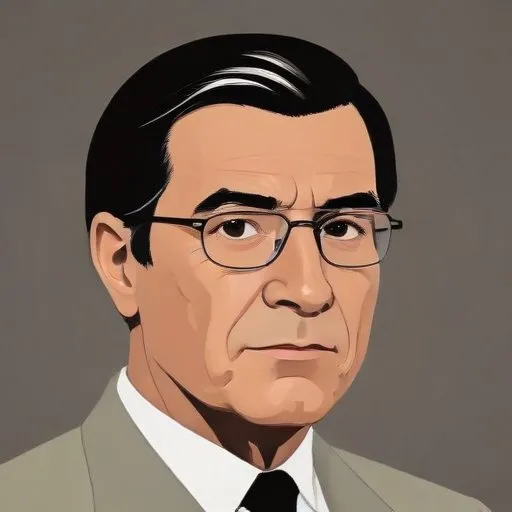
Led the country through a period of significant social and economic reform, nationalizing copper mines and implementing land redistribution, while maintaining a democratic government.
Eduardo Frei Montalva, the 27th President of Chile, is renowned for his integral role in shaping the country's political landscape during the 20th century. As a stalwart defender of democracy and social justice, he left an indelible mark on Chile's history.
Born on January 16, 1911, in Santiago, Chile, Eduardo Frei Montalva was the son of Eduard Frei Schlinz, a Swiss-born ethnic German, and Victoria Montalva Martínez. His family moved to Lontué in 1914, where his father worked as an accountant at a winery. Eduardo's early education took place at the Escuela Pública de Lontué, following which he attended the Seminario Conciliar de Santiago and later graduated from Instituto de Humanidades Luis Campino in 1928.
Frei's journey into politics began during his time at the Universidad Católica School of Law, where he became involved with the Christian Democratic Party. He quickly rose through the ranks, becoming the party's president in 1957. His commitment to social reform and economic development earned him widespread recognition, and he was elected Senator in 1958.
In 1964, Frei Montalva became the President of Chile, a position he held until 1970. During his presidency, he implemented a range of reforms aimed at promoting economic growth, social justice, and agrarian reform. His administration invested heavily in education, healthcare, and infrastructure development, earning him the nickname "the builder."
In 1970, Frei Montalva stepped down as President, but he continued to play an active role in Chilean politics. When Salvador Allende's government was overthrown in 1973, Frei's Christian Democratic Party initially supported the military coup. However, he soon became a vocal critic of the Augusto Pinochet regime, denouncing its human rights abuses and authoritarianism.
Eduardo Frei Montalva passed away on January 22, 1982, following surgery. Rumors of assassination circulated, but no conclusive evidence was found. In 2023, the Supreme Court ruled out the assassination charges, declaring the accused innocent. Despite the controversy surrounding his death, Frei Montalva's legacy as a champion of democracy and social justice endures.
Frei Montalva was married to María Ruiz-Tagle Jiménez, and they had six children together, including Eduardo Frei Ruiz-Tagle, who would later become President of Chile from 1994 to 2000.
Born in 1908
Chile's first democratically elected Marxist president, who implemented radical socialist reforms and nationalized key industries, but was overthrown in a CIA-backed coup.
Born in 1915
Chile's authoritarian leader from 1973 to 1990, known for his military coup and human rights abuses, as well as implementing free-market economic policies.
Born in 1918
Chile's first democratically elected president after Pinochet's dictatorship, he led the country's transition to democracy and implemented human rights reforms. He's known for his key role in Chile's return to democracy.
84 Years Old
Chile's 32nd President, a skilled engineer and politician, led the country's transition to democracy after Pinochet's rule, implementing economic reforms and infrastructure development. He's known for his commitment to social justice and human rights.
88 Years Old
A champion of democracy and social justice, he led Chile's transition from dictatorship to democracy, implementing reforms to reduce poverty and inequality.
75 Years Old
First female President of Chile, championing human rights and social justice, particularly for women and children.
76 Years Old
Chile's first billionaire president, known for his market-oriented economic policies and controversial handling of social unrest.
