


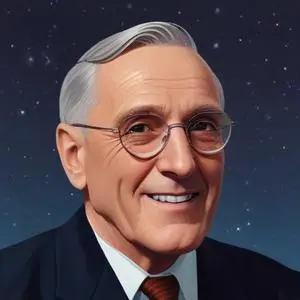
Discovered galaxies beyond our own Milky Way, revolutionizing our understanding of the universe's scale and expansion. Pioneered observational cosmology, providing evidence for the Big Bang theory.
Edwin Hubble, the pioneering American astronomer, is renowned for revolutionizing our understanding of the universe by unraveling the mysteries of extragalactic astronomy and observational cosmology. His groundbreaking discoveries, which transformed the field of astronomy, included the revelation that many "nebulae" were, in fact, galaxies beyond the Milky Way, and the establishment of the relationship between a galaxy's distance from Earth and its recession velocity, now known as Hubble's Law.
Hubble was born on November 20, 1889, in Marshfield, Missouri, to Virginia Lee Hubble (née James) and John Powell Hubble, an insurance executive. His family moved to Wheaton, Illinois, in 1900, where he grew up and developed a passion for athletics, earning recognition for his prowess in baseball, football, and track and field. Hubble's academic achievements were equally impressive, with good grades in every subject except spelling.
Hubble pursued his undergraduate studies at the University of Chicago, where he majored in astronomy and mathematics, earning his B.S. degree in 1910. He then proceeded to study at Oxford University as a Rhodes Scholar, where he developed a deep interest in astronomy. Upon his return to the United States, Hubble served in World War I and later earned his Ph.D. in astronomy from Yale University in 1923.
Hubble's academic career was marked by his affiliation with the Mount Wilson Observatory, where he worked alongside renowned astronomers like George Ellery Hale and Harlow Shapley. His research focused on Cepheid variables, which led to the development of the "distance ladder," allowing him to measure the vast distances between galaxies.
Hubble's work has had a profound impact on our understanding of the universe, pushing the boundaries of human knowledge and inspiring generations of astronomers, scientists, and thinkers. His legacy extends beyond the realm of astronomy, influencing fields like philosophy, literature, and art.
Hubble married Grace Leibour on February 25, 1924, and had no children. He passed away on September 28, 1953, leaving behind a legacy that continues to inspire and challenge humanity.
The Hubble Space Telescope, launched in 1990, stands as a testament to Hubble's enduring legacy, allowing scientists to study the universe in unprecedented detail. His work has inspired countless scientists, writers, and artists, cementing his place as one of the most influential astronomers of the 20th century.
Hubble's groundbreaking discoveries coincided with a period of great scientific and cultural upheaval, as humanity grappled with the implications of Einstein's theory of relativity and the rise of modernism in art, literature, and philosophy. Hubble's work provided a new framework for understanding the universe, shaping the course of modern astronomy and inspiring new generations of scientists and thinkers.
Born in 1879
A brilliant physicist who developed the theory of relativity and is considered one of the most influential scientists of the 20th century, known for his groundbreaking work in physics and mathematics.
Born in 1564
Pioneering astronomer, physicist, and mathematician who played a major role in the Scientific Revolution, making key discoveries that challenged Aristotelian views and laid the foundation for modern science.
Born in 1867
A pioneering scientist who pioneered radioactivity research, discovering elements polonium and radium, and paving the way for breakthroughs in medicine and energy.
Born in 1885
A pioneer in quantum mechanics, he introduced the concept of wave-particle duality, revolutionizing our understanding of atomic structure. His philosophical approach to science also explored the nature of reality and human understanding.
84 Years Old
A brilliant mind who unraveled the mysteries of black holes and the universe, making complex physics accessible to all through bestselling books.
91 Years Old
A renowned space expert who explored the universe, searching for life beyond Earth and explaining complex science in simple terms.
68 Years Old
Astrophysicist and science communicator who makes complex concepts accessible to the masses through engaging writing and hosting popular TV shows. He's a leading voice in promoting science education and critical thinking.
Born in 1920
A British scientist who contributed significantly to the discovery of the structure of DNA, providing high-quality X-ray crystallography images that helped James Watson and Francis Crick develop their famous model.
