


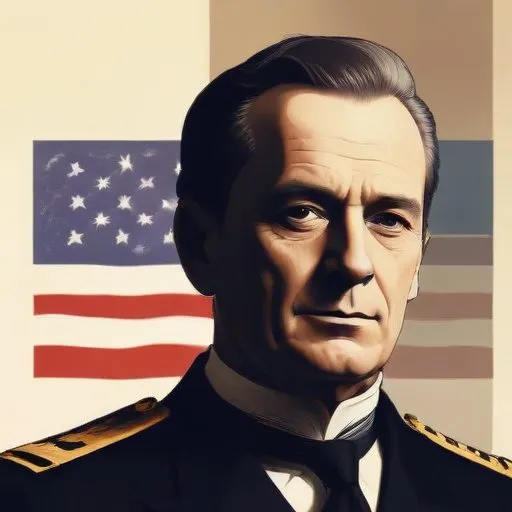
A naval intelligence expert who played a crucial role in the US Navy's preparation for the Pearl Harbor attack, providing vital insights that helped shape the country's wartime strategy.
Edwin T. Layton, a rear admiral in the United States Navy, is renowned for his exceptional work as an intelligence officer before and during World War II. He is credited with contributing significantly to the Allied forces' success, particularly in the Battle of Midway, which marked a crucial turning point in the war.
Edwin Thomas Layton was born on April 7, 1903, in Nauvoo, Illinois, to George E. Layton and Mary C. Layton. He attended the United States Naval Academy at Annapolis, Maryland, and graduated in 1924.
Layton's early career saw him spend five years with the Pacific Fleet aboard the battleship USS West Virginia and destroyer USS Chase. In 1929, he was one of a select few naval officers chosen to undergo language training in Japan.
During his time in Japan, Layton met fellow naval officer Joseph J. Rochefort, with whom he would later collaborate closely. Layton's linguistic ability and fluency in Japanese proved invaluable assets as his career progressed, particularly during World War II.
Layton was assigned to the American Embassy in Tokyo as a naval attach, where he remained for three years. During this period, he met Admiral Isoroku Yamamoto on several occasions. His experience and knowledge of Japanese culture and language allowed him to provide critical insights to the US Navy.
Layton's collaboration with Rochefort was instrumental in the Allied forces' victory at the Battle of Midway in 1942. Their combined expertise in decryption and intelligence analysis enabled them to anticipate Japanese movements, ultimately leading to a decisive victory for the US Navy.
Edwin T. Layton's work as an intelligence officer had a profound impact on the outcome of World War II. His contributions to the Battle of Midway, in particular, have been recognized as a turning point in the war. Layton's legacy serves as a testament to the importance of intelligence gathering and analysis in modern warfare.
Layton was the father of historian Edwin T. Layton, Jr. His personal life was marked by a strong sense of dedication to his family and his country.
Layton's exceptional service was recognized with several awards and honors, including the Navy Distinguished Service Medal.
Edwin T. Layton's pioneering work in intelligence gathering and analysis has had a lasting impact on modern warfare. His contributions continue to inspire and inform military strategists and intelligence officers to this day.
Through his remarkable career, Edwin T. Layton has left an indelible mark on the history of World War II, and his legacy continues to inspire future generations of military leaders and intelligence officers.
Born in 1885
Led the U.S. Pacific Fleet to victory in World War II, playing a crucial role in defeating Japan and ending the war. He was a highly respected and decorated naval leader.
Born in 1886
A highly decorated naval officer who played a crucial role in several key battles in World War II, including the Battle of Midway, and later served as a diplomat.
Born in 1884
Led the Imperial Japanese Navy during World War II, masterminding the surprise attack on Pearl Harbor, and later became a symbol of Japanese military power and strategy.
33 Years Old
A dominant center in the NBA, known for his versatile skills and clutch performances, leading the Charlotte Hornets to the playoffs in 2016.
