


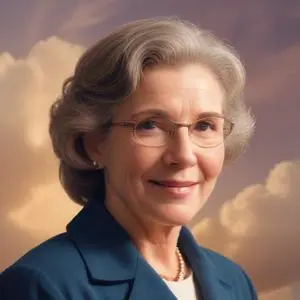
A renowned theologian and academic who uncovered and interpreted ancient Christian texts, shedding light on the early Christian movement and its diverse beliefs.
Elaine Pagels, a renowned American historian of religion, is best known for her groundbreaking research on early Christianity and Gnosticism, particularly through her bestselling book The Gnostic Gospels. This seminal work has been hailed as one of the most significant contributions to the field, offering a fresh perspective on the divisions within the early Christian church and the role of women in Jewish and Christian history.
Born on February 13, 1943, in California, Pagels grew up in an academic family, with her father, William Hiesey, being a botanist at Stanford University. Her fascination with the Gospel of John began at a young age, and she went on to develop a deep interest in the power of the New Testament.
After graduating from Stanford University with a BA in 1964 and an MA in 1965, Pagels briefly explored her passion for dance at Martha Graham's studio. She then pursued a PhD in religion at Harvard University, where she studied under the guidance of Helmut Koester and was part of a team examining the Nag Hammadi library manuscripts.
Pagels completed her PhD in 1970 and joined the faculty at Barnard College, where she headed the Department of Religion from 1974 to 1982. Her research on the Pauline Epistles and Gnosticism led to the publication of The Gnostic Paul in 1975, which proposes that Paul the Apostle was a source for Gnosticism and had a profound influence on the direction of the early Christian church.
Her magnum opus, The Gnostic Gospels, was published in 1979 and has since become a classic in the field of religious studies. The book delves into the discovery of the Nag Hammadi library manuscripts and explores the role of women in early Christianity, sparking controversy and debate among scholars and theologians.
Pagels' work has been widely recognized and acclaimed. The Gnostic Gospels was named one of the 100 best books of the 20th century by Modern Library, and she has received numerous awards, including the National Book Award and the National Humanities Medal.
Through her research, Pagels has challenged traditional views of early Christianity, emphasizing the diversity of Christian beliefs and practices in the ancient world. She has also explored the role of women in religious history, shedding light on their often-overlooked contributions.
Her work has sparked important discussions about the nature of faith, the importance of tolerance, and the need for inclusive and nuanced understandings of religious history.
In addition to her academic achievements, Pagels has been open about her personal struggles, including the loss of her young son, Mark, in 1987. This personal tragedy has deeply informed her understanding of faith and spirituality, and has influenced her approach to her research.
Elaine Pagels' work has had a profound impact on the field of religious studies, inspiring new generations of scholars and fostering a deeper understanding of early Christianity and Gnosticism. Her contributions have also extended beyond the academic realm, influencing popular culture and shaping public discourse on religion and spirituality.
Through her work, Pagels has demonstrated the power of scholarship to illuminate the complexities of human history and to foster greater empathy and understanding among people of different faiths and backgrounds.
Born in 1842
Pioneering philosopher and psychologist who explored the nature of consciousness, free will, and religious experience, and is known for his pragmatic approach to philosophy and psychology.
Born in 1875
Developed the concept of collective unconscious and archetypes, and founded analytical psychology, which emphasizes the integration of opposites and the process of individuation.
Born in 1856
Pioneering psychoanalyst who developed theories on the subconscious mind, childhood experiences, and the structure of personality, revolutionizing our understanding of human behavior and psychology.
Born in 1483
A German monk and priest who sparked the Protestant Reformation, challenging Catholic Church authority and shaping Western Christianity. He's famous for nailing 95 theses to a church door, sparking a religious revolution.
82 Years Old
A renowned scholar of comparative religion, she wrote extensively on the history of God, Islam, and Buddhism, making complex religious concepts accessible to a broad audience.
95 Years Old
A prominent religious leader and human rights advocate who fought against apartheid and racism, known for his tireless efforts to promote equality and forgiveness.
