


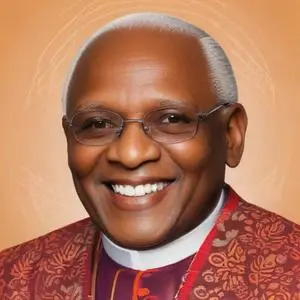
A prominent religious leader and human rights advocate who fought against apartheid and racism, known for his tireless efforts to promote equality and forgiveness.
Desmond Tutu, the renowned South African Anglican bishop and theologian, is best known for his unwavering fight against apartheid and his tireless advocacy for human rights. As a leading voice of moral authority, he played a pivotal role in shaping the country's transition from apartheid to democracy.
Tutu was born on October 7, 1931, in Klerksdorp, South Africa, to a poor family of mixed Xhosa and Motswana heritage. Despite the poverty and racial segregation that surrounded him, Tutu's parents instilled in him a strong sense of values and a desire to serve others.
After training as a teacher, Tutu was ordained as an Anglican priest in 1960. He went on to study theology at King's College London, where he was exposed to the works of theologians such as Dietrich Bonhoeffer and Martin Niemöller, whose ideas on nonviolent resistance and Christian activism greatly influenced his own philosophy.
In 1985, Tutu became the Bishop of Johannesburg, and in 1986, he was appointed as the Archbishop of Cape Town, the highest position in South Africa's Anglican hierarchy. As archbishop, Tutu used his platform to condemn apartheid and advocate for the rights of black South Africans, who were subject to systemic oppression and violence.
Tutu's leadership style was characterized by his emphasis on consensus-building and his commitment to nonviolent resistance. He worked closely with other anti-apartheid leaders, including Nelson Mandela, to bring international attention to the injustices of apartheid and to promote peaceful protests and boycotts.
Tutu's courageous activism and leadership earned him numerous awards and honors, including the Nobel Peace Prize in 1984. He also received the Albert Schweitzer International Prize, the Martin Luther King Jr. Award, and the Order of the Companions of O.R. Tambo, among many others.
Tutu's theology was deeply rooted in his African heritage and his commitment to social justice. He believed in the importance of fusionizing ideas from Black theology with African theology, emphasizing the need for a contextualized and inclusive understanding of faith.
Tutu's philosophy was also shaped by his experiences as a black South African living under apartheid. He believed in the power of forgiveness and reconciliation, and he advocated for the establishment of the Truth and Reconciliation Commission, which aimed to heal the wounds of apartheid by providing a platform for victims to share their stories and for perpetrators to confess their crimes.
Tutu's legacy extends far beyond his native South Africa. His courageous activism and leadership have inspired movements for social justice and human rights around the world. He has also been a vocal advocate for LGBTQ+ rights, women's empowerment, and environmental justice.
Today, Tutu's message of forgiveness, reconciliation, and social justice continues to resonate with people from all walks of life. His life's work serves as a powerful reminder of the importance of standing up against injustice and fighting for human dignity and equality.
Desmond Tutu's life was a testament to the power of courage, compassion, and conviction. His legacy continues to inspire generations around the world, and his message of forgiveness, reconciliation, and social justice will live on forever.
Born in 1918
A South African lawyer and politician who fought against apartheid, becoming the country's first black president and a symbol of racial reconciliation, earning a Nobel Peace Prize. He's a beacon of hope and freedom.
90 Years Old
The last State President of apartheid-era South Africa who led the country's transition to democracy and was awarded the Nobel Peace Prize for his efforts. He's known for his role in releasing Nelson Mandela from prison and dismantling the apartheid system.
84 Years Old
The second President of South Africa, a key figure in the country's transition from apartheid to democracy, known for his economic reforms and HIV/AIDS controversy.
84 Years Old
The 4th President of South Africa, a controversial figure known for his corrupt regime and multiple scandals, including bribery and racketeering charges. He was also a key figure in the fight against apartheid.
73 Years Old
The fifth President of South Africa, a leader who has played a crucial role in the country's transition to democracy and has been a key figure in the fight against apartheid. He is also a successful businessman and entrepreneur.
90 Years Old
A South African anti-apartheid activist and politician who served as the First Lady of South Africa from 1994 to 1996, known for her fight against racial segregation and her controversial yet powerful presence.
