


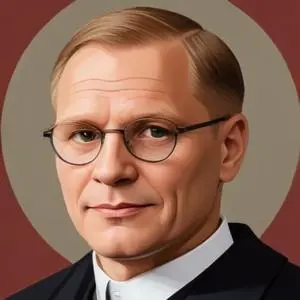
A German pastor and theologian who resisted the Nazi regime, writing influential books on faith and ethics, and ultimately giving his life for his convictions.
Dietrich Bonhoeffer, a German Lutheran pastor and theologian, is renowned for his unwavering resistance against the Nazi dictatorship and his profound writings on Christianity's role in the secular world. His seminal work, "The Cost of Discipleship," published in 1937, is considered a modern classic, offering a scathing critique of the church's complicity with the Nazi regime.
Born on February 4, 1906, in Breslau, Germany (now Poland), Bonhoeffer was the sixth of eight children to Karl and Paula Bonhoeffer. His family's emphasis on education and intellectual curiosity nurtured his curiosity, which would eventually lead him to become a prominent figure in the Confessing Church.
Bonhoeffer's theology emphasized the importance of living out one's faith in the world, rather than retreating from it. He argued that Christians had a moral obligation to resist evil and promote justice, even if it meant taking a stand against the government. His concept of "costly grace" – the idea that following Jesus demands sacrifice and obedience – has had a lasting impact on Christian thought.
As the Nazi party rose to power, Bonhoeffer became increasingly vocal in his opposition. He was a key figure in the Confessing Church, a movement that sought to preserve the integrity of the Lutheran Church in the face of Nazi ideology. Bonhoeffer's outspoken criticism of the Nazi regime's euthanasia program and its persecution of the Jews ultimately led to his arrest in 1943.
Bonhoeffer spent two years in prison, where he continued to write and minister to fellow inmates. In 1945, he was transferred to Flossenbürg concentration camp, where he was accused of being involved in the 20 July plot to assassinate Hitler. After a sham trial, Bonhoeffer was hanged on April 9, 1945, just days before the Allied forces liberated the camp.
Bonhoeffer's courage in the face of overwhelming evil has inspired generations of Christians and non-Christians alike. His writings have influenced theologians, activists, and ordinary people around the world. Today, Bonhoeffer is remembered as a symbol of resistance against injustice and a testament to the power of faith in the face of adversity.
Bonhoeffer's legacy extends beyond the theological sphere. His commitment to social justice and his willingness to challenge authority have inspired movements for civil rights, anti-apartheid, and anti-nuclear activism. His emphasis on the importance of community and accountability has influenced thinkers such as Martin Luther King Jr. and Desmond Tutu.
Born in 1886
A 20th-century theologian who redefined Christian doctrine with his emphasis on God's revelation and humanity's sinful nature, influencing modern Christian thought.
Born in 1483
A German monk and priest who sparked the Protestant Reformation, challenging Catholic Church authority and shaping Western Christianity. He's famous for nailing 95 theses to a church door, sparking a religious revolution.
Born in 1509
A French pastor and theologian who played a key role in the Protestant Reformation, shaping Christian theology and influencing Western civilization. He's famous for his teachings on predestination and his role in establishing Calvinism.
Born in 1892
A German pastor and theologian who spoke out against the Nazi regime, famously stating "First they came for the Jews..." in a powerful warning about the dangers of silence in the face of oppression.
Born in 1886
A renowned philosopher and theologian who explored the intersection of faith and modern culture, developing a unique Christian existentialist perspective that continues to influence contemporary theology and philosophy.
Born in 1884
A German Lutheran theologian and professor who demythologized the New Testament, seeking its deeper meaning beyond supernatural elements, and developed the concept of "existentialist theology".
