


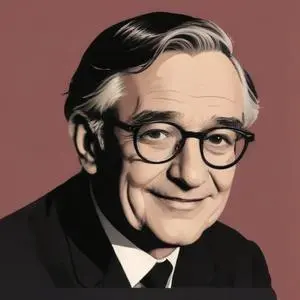
A 20th-century theologian who redefined Christian doctrine with his emphasis on God's revelation and humanity's sinful nature, influencing modern Christian thought.
Karl Barth, a Swiss Reformed theologian, is best known for his iconic commentary, The Epistle to the Romans, and his involvement in the Confessing Church, which led to the creation of the Barmen Declaration. His monumental work, Church Dogmatics, a multivolume theological summa, has had a profound impact on modern Christian theology and beyond.
Karl Barth was born on May 10, 1886, in Basel, Switzerland, to Johann Friedrich Fritz Barth and Anna Katharina Barth. He was educated at the University of Bern, where he studied theology under the influence of liberal theologians such as Adolf von Harnack and Friedrich Schleiermacher.
In 1911, Barth began his pastoral career in the rural Swiss town of Safenwil, where he became known as the "Red Pastor" due to his socialist leanings. However, it was during this time that he became disillusioned with liberal Christianity and began to question its teachings.
In 1919, Barth published the first edition of The Epistle to the Romans, which marked a significant shift in his theological perspective. He rejected the liberal theology of his education and instead focused on a more dialectical approach to theology. The second edition, published in 1921, openly broke from liberal theology and cemented Barth's reputation as a theological giant.
Barth's influence extends far beyond the academic realm, reaching into mainstream culture. He has been featured on the cover of Time magazine and has inspired numerous theologians, including Dietrich Bonhoeffer, Jrgen Moltmann, and Helmut Gollwitzer. His work has also influenced novelists such as Flannery O'Connor and John Updike.
Barth's magnum opus, Church Dogmatics, is a multivolume work that took over 35 years to complete. It is considered one of the most significant theological works of the 20th century. Additionally, Barth was a key figure in the creation of the Barmen Declaration, a theological statement that opposed the Nazi regime's ideology.
In 1935, Barth was dismissed from his professorship at the University of Bonn due to his opposition to the Nazi regime. He continued to write and teach, eventually returning to Switzerland in 1935.
Karl Barth passed away on December 10, 1968, leaving behind a legacy that continues to shape modern Christian theology and beyond.
"Faith is not a feeling, but an act of obedience."
"The Bible is the book of the Church, and the Church is the people of the Bible."
Karl Barth's theology emerged during a time of great turmoil and upheaval in Europe. His work provided a beacon of hope and a call to action for many Christians during the Nazi regime and beyond. Today, his legacy continues to inspire theologians, scholars, and laypeople alike.
In conclusion, Karl Barth's influence on modern Christian theology is immeasurable. His work continues to shape our understanding of God, the Church, and our place in the world. As we reflect on his life and legacy, we are reminded of the power of faith and the importance of standing up for what is right, even in the face of adversity.
Born in 1906
A German pastor and theologian who resisted the Nazi regime, writing influential books on faith and ethics, and ultimately giving his life for his convictions.
Born in 1483
A German monk and priest who sparked the Protestant Reformation, challenging Catholic Church authority and shaping Western Christianity. He's famous for nailing 95 theses to a church door, sparking a religious revolution.
Born in 1509
A French pastor and theologian who played a key role in the Protestant Reformation, shaping Christian theology and influencing Western civilization. He's famous for his teachings on predestination and his role in establishing Calvinism.
Born in 1813
A Danish philosopher and author who is considered the father of existentialism, known for his philosophical and theological writings that emphasized individualism and subjective experience.
Born in 1768
A pioneering theologian and philosopher who shaped modern Christian thought and hermeneutics, known for his emphasis on individual experience and understanding of religious texts.
Born in 1884
A German Lutheran theologian and professor who demythologized the New Testament, seeking its deeper meaning beyond supernatural elements, and developed the concept of "existentialist theology".
Born in 1886
A renowned philosopher and theologian who explored the intersection of faith and modern culture, developing a unique Christian existentialist perspective that continues to influence contemporary theology and philosophy.
Born in 1892
A prominent mid-20th-century theologian and academic who developed the concept of "Christian realism," which emphasizes the role of sin and self-interest in human nature, influencing modern political and social thought.
