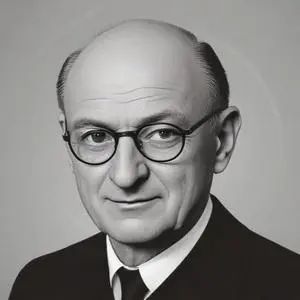
Reinhold Niebuhr: The Theologian and Public Intellectual Who Shaped 20th-Century Thought
A Life of Intellectual Pursuit and Public Engagement
Reinhold Niebuhr was a renowned American Reformed theologian, ethicist, and commentator on politics and public affairs, who spent over three decades as a professor at Union Theological Seminary. His influential works, including
Moral Man and Immoral Society and
The Nature and Destiny of Man, solidified his position as one of America's leading public intellectuals of the 20th century.
Early Life and Ministry
Born on June 21, 1892, in Wright City, Missouri, Niebuhr was raised in a family of German immigrants. He studied at Elmhurst College, Eden Theological Seminary, and Yale University, where he earned his Bachelor of Divinity degree in 1914. Niebuhr began his ministry in Detroit, Michigan, where he developed sympathies for the working class and advocated for pacifism and socialism.
The Evolution of Christian Realism
During the 1930s, Niebuhr's thinking evolved towards neoorthodox realist theology, as he developed the philosophical perspective known as Christian realism. This shift was characterized by a critique of utopianism as ineffective in dealing with reality. Niebuhr's realism deepened after 1945, leading him to support American efforts to confront Soviet communism globally.
Influence on Modern Society
Niebuhr's contributions to political philosophy, particularly his use of theology to argue for political realism, have had a profound impact on international relations theory. His work has influenced scholars across disciplines, including political scientists, political historians, and theologians. His influence extends beyond academia, with activists and politicians also drawing upon his ideas.
Awards and Honors
In recognition of his contributions, Niebuhr received the Presidential Medal of Freedom in 1964.
Philosophical Contributions and Beliefs
- Christian realism: Niebuhr's philosophical perspective, which emphasizes the need for a realistic understanding of human nature and the importance of moral responsibility in politics.
- Critique of utopianism: Niebuhr argued that utopianism is ineffective in dealing with reality, as it fails to account for human sin and the complexities of politics.
- Neoorthodox theology: Niebuhr's theological approach, which emphasized the importance of sin, grace, and redemption in understanding human nature and society.
Personal Milestones and Key Life Events
- 1928: Niebuhr became a professor at Union Theological Seminary, a position he held for over 30 years.
- 1932: He published Moral Man and Immoral Society, which established him as a leading public intellectual.
- 1941-1943: Niebuhr served as chairman of the Commission on a Just and Durable Peace, a organization that aimed to establish a just and lasting peace in the post-war world.
Quotes and Memorable Sayings
- "The sad duty of politics is to establish justice in a sinful world."
- "Man's capacity for justice makes democracy possible, but man's inclination to injustice makes democracy necessary."
Historical Context and Legacy
Niebuhr's life and work must be understood within the context of the 20th century, marked by two world wars, the rise of communism, and the civil rights movement. His contributions to theology, ethics, and political philosophy continue to influence scholars, activists, and politicians today.
Comparative Analysis with Contemporaries
Niebuhr is often compared to his intellectual rival,
John Dewey, with whom he disagreed on the nature of human nature and the role of government in society. While Dewey advocated for a more optimistic view of human nature, Niebuhr emphasized the importance of moral responsibility and the limitations of human knowledge.
Personal Relationships and Anecdotes
Niebuhr's relationships with his students and colleagues were marked by a sense of mentorship and intellectual curiosity. He was known for his engaging lectures and his ability to inspire students to think critically about complex moral and political issues.
FAQ
What were Reinhold Niebuhrs main theological contributions?
Reinhold Niebuhr was an American theologian and academic who developed the concept of Christian realism, which emphasizes the role of sin and self-interest in human nature. He also wrote extensively on the relationship between Christianity and politics.
What is Reinhold Niebuhrs most famous work?
Niebuhrs most famous work is his book Moral Man and Immoral Society, which explores the tension between individual morality and societal ethics. He also wrote The Nature and Destiny of Man, a comprehensive theology of human nature.
How did Reinhold Niebuhrs theology influence American politics?
Niebuhrs ideas about the limitations of human nature and the need for moral responsibility in politics have influenced many American politicians and thinkers, including Martin Luther King Jr. and Barack Obama.
What awards and recognition did Reinhold Niebuhr receive?
Niebuhr received the Presidential Medal of Freedom in 1964 and was awarded honorary degrees from numerous universities. He was also elected to the American Academy of Arts and Sciences.
What was Reinhold Niebuhrs view on the role of the church in society?
Niebuhr believed that the church had a critical role to play in promoting social justice and moral values in society. He advocated for the church to be a prophetic voice, challenging injustice and promoting peace and equality.