


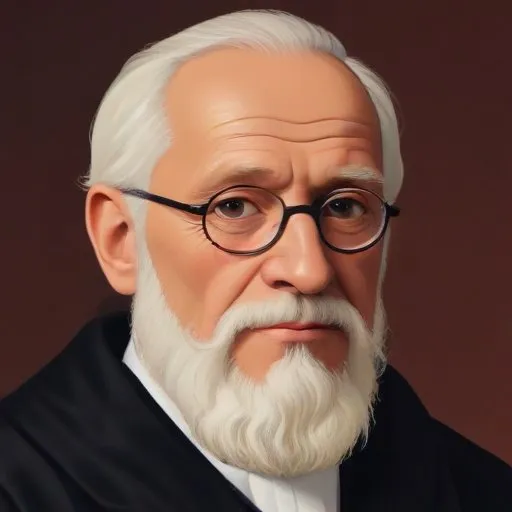
A pioneering theologian and philosopher who shaped modern Christian thought and hermeneutics, known for his emphasis on individual experience and understanding of religious texts.
Friedrich Schleiermacher is renowned for his groundbreaking attempts to reconcile the criticisms of the Enlightenment with traditional Protestant Christianity, earning him the title of the "Father of Modern Liberal Theology." His work has had a profound impact on Christian thought, shaping the trajectory of liberal Christianity and influencing prominent theologians such as Karl Barth.
Born on November 21, 1768, in Breslau, Prussian Silesia, Schleiermacher was the grandson of a pastor and the son of a Reformed Church chaplain. He began his formal education at a Moravian school in Niesky, Upper Lusatia, and later attended the University of Halle, where he was exposed to the rationalist spirit of Christian Wolff and Johann Salomo Semler.
Schleiermacher's theology was deeply rooted in his Romanticist philosophy, which emphasized the importance of individual experience and emotion. He believed that religion should be based on personal experience and feeling, rather than dogmatic doctrine. This approach led him to develop a more liberal and inclusive understanding of Christianity, which emphasized social justice and individual freedom.
Schleiermacher's academic career spanned over four decades, during which he held various positions at the University of Halle and the University of Berlin. His most notable works include:
Schleiermacher's ideas have had a lasting impact on modern society, shaping the development of liberal Christianity and influencing prominent theologians and philosophers. His emphasis on individual freedom and social justice paved the way for the civil rights movement and continues to inspire social reform.
Schleiermacher's life was marked by significant personal milestones, including:
Schleiermacher's work has been the subject of both praise and criticism, with some viewing him as a visionary and others seeing him as a threat to traditional Christianity. Despite the controversy, his influence on modern Christian thought is undeniable, and his work continues to shape the trajectory of liberal Christianity.
In conclusion, Friedrich Schleiermacher was a theologian, philosopher, and biblical scholar who left an indelible mark on Christian thought. His attempts to reconcile the Enlightenment with traditional Protestant Christianity paved the way for the development of liberal Christianity, shaping the course of modern theology and continuing to inspire social reform.
Born in 1724
Developed influential philosophical frameworks, such as the Critique of Pure Reason, that shaped modern Western thought on ethics, morality, and human understanding.
Born in 1770
A German philosopher and academic who developed a comprehensive and systematic philosophy that emphasized the unity of all things and the dialectical process of thesis, antithesis, and synthesis. His ideas have had a profound impact on modern thought, influencing fields such as philosophy, politics, and art.
Born in 1788
A pessimistic philosopher who wrote about the human condition, emphasizing the struggles and sufferings of life, and is famous for his concept of the "will to life".
Born in 1632
A 17th-century philosopher and scholar who developed a comprehensive philosophical system that emphasizes God, nature, and human freedom, influencing modern thought on ethics, politics, and religion.
