


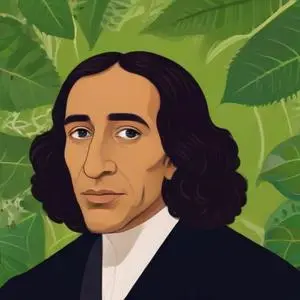
A 17th-century philosopher and scholar who developed a comprehensive philosophical system that emphasizes God, nature, and human freedom, influencing modern thought on ethics, politics, and religion.
Baruch Spinoza, also known as Benedictus de Spinoza, is renowned for his profound philosophical contributions that paved the way for modern biblical criticism, 17th-century rationalism, and Dutch intellectual culture. As a leading philosopher of the early modern period, Spinoza's radical ideas challenged traditional views on God, human freedom, and the role of ecclesiastic authority in the state.
Spinoza was born on November 24, 1632, in Amsterdam to a Marrano family that fled Portugal to escape persecution. His father, a prominent merchant, provided him with a traditional Jewish education, where he learned Hebrew and studied sacred texts within the Portuguese Jewish community. However, Spinoza's inquisitive nature and critical thinking soon led him to challenge rabbinic authority and question Jewish doctrines.
In 1656, Spinoza's persistent questioning of traditional beliefs resulted in his permanent expulsion from the Jewish community. This event marked a turning point in his life, as he distanced himself from all religious affiliations and devoted himself to philosophical inquiry and lens grinding.
Spinoza's most influential works, "Tractatus Theologico-Politicus" and "Ethics," showcase his commitment to rationalism and pantheism. He argued that God is not a personal deity but a unified, underlying substance that constitutes the universe. This view led him to reject the concept of an afterlife and emphasize the importance of living in the present.
Spinoza's ideas have had a profound impact on modern thought, influencing prominent philosophers such as Immanuel Kant, Friedrich Nietzsche, and Georg Wilhelm Friedrich Hegel. His advocacy for individual liberty, secularism, and democracy paved the way for the Enlightenment and shaped the modern Western worldview.
Spinoza's most notable works include:
Spinoza's life was marked by controversy and persecution. He attracted a dedicated circle of followers, who gathered to discuss his writings and joined him in the intellectual pursuit of truth. Despite facing persecution and bans on his books, Spinoza remained committed to his philosophical inquiry.
Baruch Spinoza's radical ideas and contributions have left an indelible mark on Western philosophy. His emphasis on reason, individual liberty, and democracy continues to inspire generations of thinkers and scholars. As a forerunner of the Age of Enlightenment, Spinoza's legacy serves as a testament to the power of human inquiry and the pursuit of truth.
Born in 1632
A 17th-century thinker who laid the groundwork for modern democracy, arguing that governments derive their power from the people and that individuals have inherent rights to life, liberty, and property.
Born in 1646
Developed calculus independently of Isaac Newton, and made major contributions to the fields of philosophy, politics, and history.
Born in 1724
Developed influential philosophical frameworks, such as the Critique of Pure Reason, that shaped modern Western thought on ethics, morality, and human understanding.
Born in 1712
A pioneering thinker who shaped modern democracy and education with his ideas on social contracts, general will, and the importance of early childhood education. His writings influenced the French Revolution and modern political thought.
Born in 1694
A witty and insightful 18th-century writer and philosopher who used satire to critique societal norms and advocate for reason, tolerance, and human rights.
Born in 1711
A Scottish Enlightenment thinker who developed influential ideas on morality, ethics, and human nature, and is considered one of the most important figures in the history of Western philosophy.
Born in 1561
A 16th-17th century Renaissance figure who pioneered the scientific method and empiricism, and served as a prominent government official.
Born in 1588
A 17th-century philosopher who introduced the concept of social contract, arguing that people voluntarily give up some rights to a sovereign power in exchange for protection and stability. His ideas shaped modern political thought and the nature of government.
