


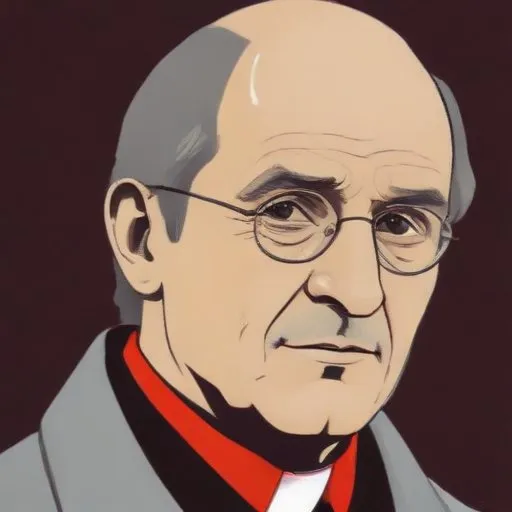
A prominent Protestant theologian and author, known for his work on Christian social ethics and his opposition to Nazism, influencing modern Christian thought on social justice.
Helmut Gollwitzer, a renowned German Protestant Lutheran theologian and author, is best known for his fearless stance against the Nazi regime and his unwavering commitment to pacifism. Through his writings and teachings, Gollwitzer inspired generations to stand up against oppression and fight for social justice.
Born on December 29, 1908, in Pappenheim, Bavaria, Gollwitzer was raised in a family deeply rooted in Christian values. This early exposure to faith would shape his future and inform his theological pursuits.
Gollwitzer studied Protestant theology in Munich, Erlangen, Jena, and Bonn between 1928 and 1932. He later completed his doctorate under the esteemed theologian Karl Barth in Basel, Switzerland, in 1937. His dissertation, which explored the understanding of the Eucharist in Martin Luther and John Calvin, showcased his erudite approach to theological inquiry.
During the tumultuous period of the Nazi regime in Germany, Gollwitzer emerged as a vocal critic of the government's attempts to control the churches. As a member of the Confessing Church movement, he defied the regime's oppressive policies, even taking over as the pastor of the congregation at Berlin-Dahlem after the arrest of Martin Niemöller.
During World War II, Gollwitzer served as a medic on the Eastern Front, where he witnessed firsthand the horrors of war. Following the war, he was taken prisoner by the Soviet Union and held captive from 1945 to 1949. This period of captivity would later inspire his bestselling book, Unwilling Journey: A Diary from Russia, which was hailed by then-President of West Germany, Theodor Heuss, as a "great historical document."
Upon his release, Gollwitzer was appointed professor of systematic theology at the University of Bonn (1950-1957) and later professor of Protestant theology at the Free University of Berlin, where he taught until his retirement in 1975. His academic appointments were punctuated by his close relationship with Karl Barth, whom he was nearly chosen to succeed in Basel, but was rejected due to his perceived "unclear attitude" towards the Soviet Union.
Gollwitzer's commitment to pacifism and social justice only intensified in the later years of his life. He was a close friend of Rudi Dutschke, a prominent figure in the German student movement, and served as a pastor to Ulrike Meinhof, a founding member of the Red Army Faction. Gollwitzer's opposition to nuclear weapons and his advocacy for peace made him a respected voice in the international community.
Through his life's work, Helmut Gollwitzer left an indelible mark on the world of theology and beyond. His courage in the face of oppression, his commitment to pacifism, and his tireless advocacy for social justice continue to inspire generations. As W. Travis McMaken so aptly puts it in his book, Our God Loves Justice: An Introduction to Helmut Gollwitzer, Gollwitzer's legacy serves as a testament to the power of faith and conviction in the pursuit of a more just and peaceful world.
Born in 1906
A German pastor and theologian who resisted the Nazi regime, writing influential books on faith and ethics, and ultimately giving his life for his convictions.
97 Years Old
A prominent leader in the civil rights movement, advocating for racial equality and social justice through nonviolent means, leaving a lasting impact on American history.
Born in 1886
A 20th-century theologian who redefined Christian doctrine with his emphasis on God's revelation and humanity's sinful nature, influencing modern Christian thought.
Born in 1884
A German Lutheran theologian and professor who demythologized the New Testament, seeking its deeper meaning beyond supernatural elements, and developed the concept of "existentialist theology".
Born in 1886
A renowned philosopher and theologian who explored the intersection of faith and modern culture, developing a unique Christian existentialist perspective that continues to influence contemporary theology and philosophy.
Born in 1904
A German priest and theologian who sought to reconcile Catholicism with modern philosophy, exploring the intersection of faith and reason. His work greatly influenced 20th-century Catholic theology.
98 Years Old
A prominent Catholic theologian and prolific author, known for his progressive views on Christianity and criticism of the Catholic Church's authority. He wrote extensively on theology, ethics, and politics.
Born in 1926
A German theologian and academic who developed a unique blend of Christian theology and social activism, advocating for a more inclusive and just society. He's known for his work on the theology of hope and the concept of "the crucified God".
