


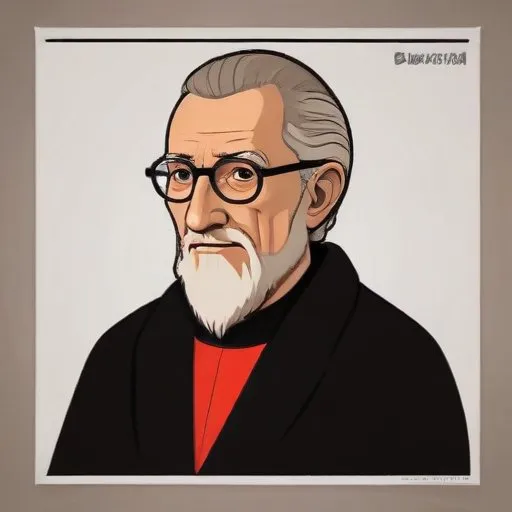
A prominent Catholic theologian and prolific author, known for his progressive views on Christianity and criticism of the Catholic Church's authority. He wrote extensively on theology, ethics, and politics.
Hans Küng was a renowned Swiss Catholic priest, theologian, and author known for his progressive views on Christianity and his advocacy for interfaith dialogue. As a prominent voice in the Catholic Church, Küng was both praised and criticized for his critiques of traditional dogma, earning him a reputation as a champion of reform.
Born on March 19, 1928, in Sursee, Canton of Lucerne, Switzerland, Küng was the eldest of seven siblings. His father managed a shoe store, and the family's strong Catholic roots instilled in him a deep sense of faith from an early age.
Küng studied philosophy and theology at the Pontifical Gregorian University in Rome, where he was ordained as a priest in 1954. He continued his education at various European institutions, including the Sorbonne and the Institut Catholique de Paris, earning a doctorate in theology in 1957.
Küng's theological views often challenged traditional Catholic doctrine, particularly the concept of papal infallibility. His 1971 book, Infallible? An Inquiry, sparked controversy and led to his dismissal as a Catholic theologian. However, he remained a professor of ecumenical theology at the University of Tübingen until his retirement in 1996.
Despite the backlash, Küng remained committed to his vision of a more inclusive and dialogue-driven Christianity. He wrote extensively on interfaith dialogue, publishing Christianity and the World Religions: Paths of Dialogue with Islam, Hinduism, and Buddhism in 1986.
In recognition of his contributions to theology and interfaith dialogue, Küng received numerous awards and honors, including the Otto Hahn Peace Medal in 2008.
Hans Küng's legacy extends beyond the Catholic Church, inspiring a new generation of theologians and scholars to engage in interfaith dialogue and critically evaluate traditional dogma. His work continues to influence modern society, fostering greater understanding and tolerance between different religious traditions.
An asteroid was named in his honor, a testament to his enduring impact on the world.
Hans Küng's remarkable life was marked by significant milestones, from his ordination as a priest to his presidency of the Foundation for a Global Ethic. His legacy continues to inspire and challenge people around the world.
Born in 1904
A German priest and theologian who sought to reconcile Catholicism with modern philosophy, exploring the intersection of faith and reason. His work greatly influenced 20th-century Catholic theology.
97 Years Old
A German theologian and author who wrote extensively on feminist theology, politics, and spirituality, challenging traditional Christian dogma and advocating for social justice. 42
Born in 1926
A German theologian and academic who developed a unique blend of Christian theology and social activism, advocating for a more inclusive and just society. He's known for his work on the theology of hope and the concept of "the crucified God".
93 Years Old
A prominent Catholic theologian and cardinal who played a key role in shaping the Church's stance on ecumenism, interfaith dialogue, and social justice. He's known for his efforts to promote Christian unity and understanding.
81 Years Old
A prominent Catholic leader and theologian, known for his influential writings on Catholic doctrine and his role in shaping the Church's stance on various issues.
84 Years Old
A prominent Catholic leader and philosopher, known for his intellectual approach to theology and his potential to become Pope. He has written extensively on various philosophical and theological topics.
