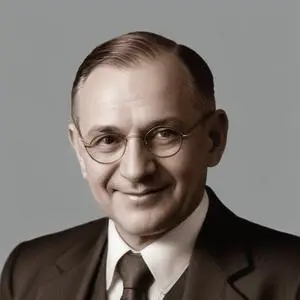
Otto Hahn

Otto Hahn

Otto Hahn was born on March 8th, 1879

Full Name: Otto Hahn
Place of Birth: Frankfurt am Main, Germany
Profession: Chemist, Academic
Birth Date: March 8, 1879
Zodiac Sign: Pisces
Death Date: July 28, 1968
Notable Achievements: Nobel Prize in Chemistry
Education: University of Marburg

A pioneering nuclear chemist who discovered nuclear fission, a process that releases massive energy from atomic nuclei, and was awarded the Nobel Prize in Chemistry in 1944.

Timeline
1879
Born in Frankfurt
Otto Hahn was born on March 8, 1879, in Frankfurt, Germany. He would go on to become a Nobel Prize-winning chemist.
1904
Discovers radioactive thorium
Hahn discovered radioactive thorium, a key finding that would lead to further research in radiochemistry.
1938
Discovers nuclear fission
Hahn and his assistant Fritz Strassmann discovered nuclear fission, a groundbreaking discovery that would change the course of modern physics.
1944
Awards Nobel Prize in Chemistry
Hahn was awarded the Nobel Prize in Chemistry for his discovery of nuclear fission, a testament to his groundbreaking work in radiochemistry.
1968
Dies in Göttingen
Otto Hahn died on July 28, 1968, at the age of 89, in Göttingen, Germany, leaving behind a legacy as one of the greatest chemists of the 20th century.
Otto Hahn

Otto Hahn Quiz

What is the process discovered by Otto Hahn that releases massive energy from atomic nuclei?

Score: 0/5
FAQ
What was Otto Hahns contribution to nuclear physics?
Otto Hahn was a German chemist and nuclear physicist who made groundbreaking contributions to our understanding of nuclear reactions. He is best known for his discovery of nuclear fission, a process that releases immense energy from atomic nuclei.
How did Otto Hahns discovery of nuclear fission impact the course of history?
Otto Hahns discovery of nuclear fission had far-reaching consequences, leading to the development of atomic energy and nuclear weapons. His work paved the way for significant advances in fields such as medicine, energy production, and national security.
What was Otto Hahns role in the discovery of the elements?
Otto Hahn was a pioneer in the discovery of new elements, including protactinium, protactinium-234, and several other radioactive isotopes. His work in this area expanded our understanding of the periodic table and the properties of elements.
How did Otto Hahns collaboration with Lise Meitner influence their research?
Otto Hahns collaboration with Lise Meitner was a crucial factor in their research on nuclear physics. Their partnership, which spanned several decades, led to numerous breakthroughs and a deeper understanding of nuclear reactions and the structure of atomic nuclei.
What was Otto Hahns legacy in the scientific community?
Otto Hahns legacy in the scientific community is one of innovation, collaboration, and dedication. He is remembered as a pioneering scientist who made significant contributions to our understanding of nuclear physics, and his work continues to influence research in this field.

Related People:

Lise Meitner

Born in 1878

Pioneering physicist who made groundbreaking contributions to nuclear physics, including the discovery of nuclear fission, and was the first woman to become a full professor of physics in Germany.

Albert Einstein

Born in 1879

A brilliant physicist who developed the theory of relativity and is considered one of the most influential scientists of the 20th century, known for his groundbreaking work in physics and mathematics.

Enrico Fermi

Born in 1901

A pioneer in nuclear physics, known for leading the team that developed the first nuclear reactor and playing a crucial role in the development of the atomic bomb.

Niels Bohr

Born in 1885

A pioneer in quantum mechanics, he introduced the concept of wave-particle duality, revolutionizing our understanding of atomic structure. His philosophical approach to science also explored the nature of reality and human understanding.

Werner Heisenberg

Born in 1901

A pioneer in quantum mechanics, he formulated the uncertainty principle, which revolutionized our understanding of the atomic world. His groundbreaking work reshaped modern physics.

Marie Curie

Born in 1867

A pioneering scientist who pioneered radioactivity research, discovering elements polonium and radium, and paving the way for breakthroughs in medicine and energy.

Pierre Curie

Born in 1859

A pioneer in radioactivity research, discovering elements like polonium and radium, and pioneering radioactive isolation techniques. Their groundbreaking work paved the way for advancements in medicine, energy, and materials science.