


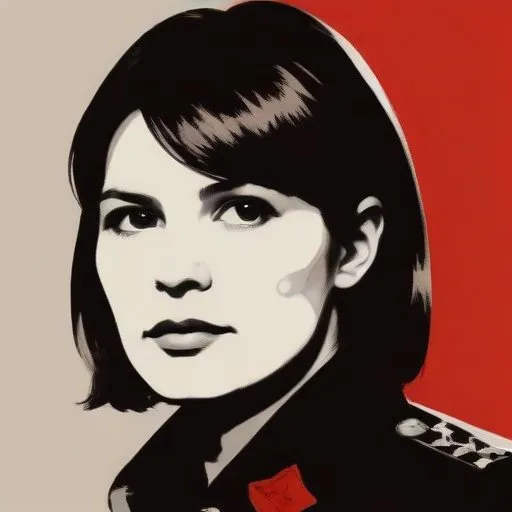
Co-founder of the Red Army Faction, a radical left-wing terrorist group in Germany, known for her involvement in violent protests and bombings. She was a journalist turned militant, sparking controversy and debate about political extremism.
Ulrike Meinhof, a German left-wing journalist, is infamously known for her role as a founding member of the Red Army Faction (RAF), a militant organization that shook West Germany in the 1970s. Her radical ideology and involvement in the group's violent protests and bombings earned her the reputation as a leading figure of the radical left.
Born on October 7, 1934, in Oldenburg, Germany, Meinhof's life was marked by tragedy and instability. Her father, Werner Meinhof, passed away from cancer in 1940, and her mother, Ingeborg Meinhof, an art historian, took in a boarder to support the family. After her mother's death in 1949, Meinhof's guardian, Renate Riemeck, played a significant role in her life.
In the 1950s, Meinhof became involved in student activism, attending the University of Marburg, where she studied philosophy, sociology, education, and German. Her involvement in the student movement laid the groundwork for her future radical pursuits.
In 1971, Meinhof co-authored the manifesto "The Urban Guerilla Concept," which condemned reformism and called for armed struggle as the highest form of Marxism-Leninism. This ideology became the foundation of the RAF's violent protests and bombings, which aimed to overthrow the West German government.
In May 1972, Meinhof participated in the RAF's May Offensive, a series of violent attacks on police stations and banks. She was arrested in June of that year and spent the rest of her life in custody, largely isolated from outside contact.
In 1974, Meinhof was sentenced to eight years in prison for her involvement in the RAF's jailbreak operation. She stood trial on multiple charges of murder and attempted murder alongside other RAF leaders. Before the trial's conclusion, Meinhof was found hanged in her cell in Stammheim Prison on May 9, 1976. The official ruling of suicide sparked controversy, with many doubting the circumstances of her death.
Meinhof's radical ideology and involvement in the RAF's violent protests have left a lasting impact on German politics and society. Her death sparked a wave of protests and riots, and her legacy continues to inspire and provoke debate among left-wing activists today.
Despite her controversial life and death, Ulrike Meinhof's legacy serves as a testament to the power of radical ideology and the enduring impact of the Red Army Faction on modern society.
83 Years Old
Co-founder of a radical left-wing militant group, responsible for a series of bombings, assassinations, and kidnappings in Germany during the 1970s, sparking widespread fear and outrage.
85 Years Old
A German militant leader who co-founded the Red Army Faction, a radical left-wing group responsible for a series of bombings, kidnappings, and assassinations in the 1970s. Known for their violent protests against capitalism and imperialism.
96 Years Old
A prominent thinker who developed the concept of "communicative action" and explored the relationships between power, language, and social structures, influencing modern critical theory and sociology.
81 Years Old
A French-German educator and politician who advocated for student rights and democratic reforms, known for his leadership in the 1968 Paris student uprising.
