


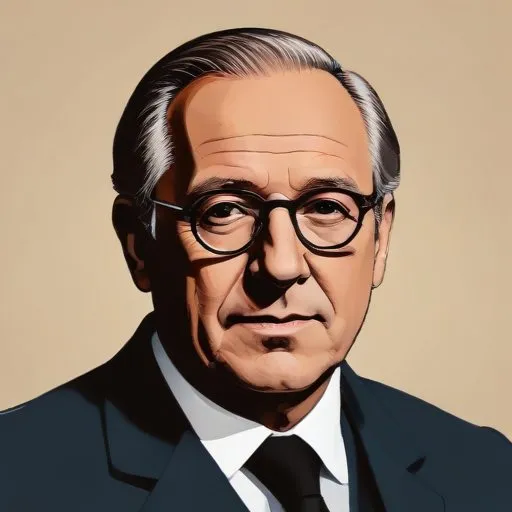
A French-German educator and politician who advocated for student rights and democratic reforms, known for his leadership in the 1968 Paris student uprising.
Daniel Cohn-Bendit is a name synonymous with European politics, known for his fiery passion and unwavering commitment to federalism. Born on April 4, 1945, this French-German politician has left an indelible mark on the European political landscape, earning him the nickname "Dany le Rouge" or "Danny the Red" due to his leftist ideologies and fiery red hair.
Cohn-Bendit's journey to prominence began during the tumultuous May 1968 protests in France, where he emerged as a student leader and vocal advocate for social change. His charismatic leadership and radical ideas resonated with the youth, earning him a reputation as a champion of democratic reform. In the aftermath of the protests, Cohn-Bendit co-authored the influential book Obsolete Communism: The Left-Wing Alternative with his brother Gabriel, critiquing Stalinism and the French Communist Party.
Cohn-Bendit's political ideology is deeply rooted in libertarian socialism, drawing inspiration from the works of Cornelius Castoriadis, Pierre Chaulieu, and Claude Lefort. He has consistently advocated for a more decentralized, democratic, and united Europe, where citizens have a greater say in shaping their own destiny.
In 2001, Cohn-Bendit faced backlash for his 1976 article in the cultural-political magazine das da, in which he graphically described engaging in sexual activities with children under his care at a Frankfurt kindergarten. He later claimed the article was an "obnoxious provocation" and not based on real events. The controversy resurfaced in 2013 with the discovery of a recording where Cohn-Bendit described an "incredibly erotic game" with a minor.
Cohn-Bendit's contributions to European politics and his tireless advocacy for federalism have left a lasting impact on modern society. Despite controversies, his unwavering commitment to democratic values and human rights has inspired generations of European politicians and activists. As a champion of European integration, Cohn-Bendit's legacy continues to shape the continent's political landscape.
"The European Union is not a state, but it must have state-like functions."
"We need a European republic, a united Europe, a Europe of citizens."
"The European project is not a utopia, but a necessity."
78 Years Old
A German academic and politician who served as Foreign Minister and Vice Chancellor of Germany from 1998 to 2005, known for his leadership during the Kosovo War and his advocacy for European integration.
82 Years Old
The 7th Chancellor of Germany, a lawyer-turned-politician, led the country from 1998 to 2005, implementing significant economic and social reforms. He's known for his efforts to modernize Germany and strengthen the European Union.
72 Years Old
The first female Chancellor of Germany, serving for 16 years, known for her leadership during the European sovereign-debt crisis and her role in shaping the European Union's policy. She's a highly influential figure in modern politics.
72 Years Old
The 24th President of France, a key European leader who implemented significant economic reforms and played a crucial role in shaping the European Union's policies, particularly during the European sovereign-debt crisis.
