


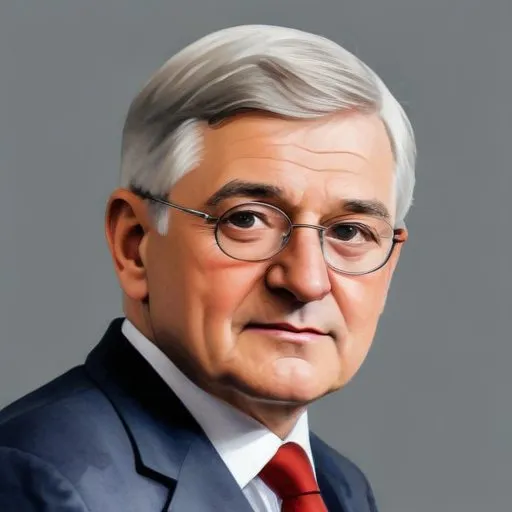
A German academic and politician who served as Foreign Minister and Vice Chancellor of Germany from 1998 to 2005, known for his leadership during the Kosovo War and his advocacy for European integration.
Joschka Fischer, born on April 12, 1948, is a German politician who made history as the first Green Party member to hold a ministerial post in Germany. He served as the Foreign Minister and Vice Chancellor of Germany from 1998 to 2005, leaving an indelible mark on the country's politics and environmental policies.
Fischer was born in Gerabronn, Wurttemberg-Baden, to a family of butchers who had lived in Hungary for generations. His family was forced to leave Hungary in 1946 due to ethnic persecution, and he was brought up Catholic in Oeffingen. Fischer dropped out of high school in 1965 and began an apprenticeship as a photographer, which he quit in 1966.
In 1967, Fischer became an active member of the German student movement and left-wing movement, participating in protests against the Vietnam War and advocating for environmental protection. He was part of the "Spontis," a radical left-wing group that emerged in the 1960s. Fischer worked at a left-wing bookstore in Frankfurt to make ends meet while pursuing his political passions.
Fischer's dedication to environmental issues led him to join the Green Party in 1983. He quickly rose through the ranks, becoming a key figure in the party. In 1994, he was elected as the Minister of the Environment and Energy in the state of Hesse, where he implemented groundbreaking policies to promote renewable energy and reduce carbon emissions.
In 1998, Fischer was appointed as the Foreign Minister and Vice Chancellor of Germany in the cabinet of Gerhard Schröder. During his tenure, he played a crucial role in shaping Germany's foreign policy, advocating for European integration, and promoting a more active role for Germany in international affairs. Fischer was instrumental in shaping the EU's Common Foreign and Security Policy and was a strong supporter of the Kyoto Protocol.
In 2010, Fischer supported the creation of the Spinelli Group, a Eurolarliamentarian initiative aimed at reinvigorating efforts to federalize the European Union. He has consistently advocated for a more integrated and federal Europe, believing it is essential for the continent's prosperity and stability.
Joschka Fischer's legacy is that of a trailblazer in environmental politics and European integration. He has inspired generations of politicians and activists to prioritize sustainable development and international cooperation. As a leading figure in the German Greens, Fischer has left an indelible mark on the country's political landscape.
Fischer believes in the power of grassroots movements and civil society to drive change. He is a strong advocate for environmental protection, social justice, and human rights. His commitment to European integration is rooted in his belief that a united Europe is essential for peace, stability, and prosperity.
"Europe is not just a geographical concept, but a community of values."
"The environment is not just a moral obligation, but a matter of national security."
82 Years Old
The 7th Chancellor of Germany, a lawyer-turned-politician, led the country from 1998 to 2005, implementing significant economic and social reforms. He's known for his efforts to modernize Germany and strengthen the European Union.
71 Years Old
The first female Chancellor of Germany, serving for 16 years, known for her leadership during the European sovereign-debt crisis and her role in shaping the European Union's policy. She's a highly influential figure in modern politics.
Born in 1918
A German leader who served as Chancellor from 1974 to 1982, known for his pragmatic and socially liberal policies, and his key role in shaping the European Union. He was also a respected economist and published author.
Born in 1913
A German statesman who served as Chancellor of Germany, known for his efforts to reconcile with Eastern Europe and his "Ostpolitik" policy, earning him a Nobel Peace Prize.
96 Years Old
The first unified Germany's leader, who oversaw the country's reunification after the Berlin Wall's fall, and is credited with creating a strong, stable economy.
99 Years Old
A German statesman who served as Vice-Chancellor and Foreign Minister, playing a key role in reunifying Germany and shaping European politics. He's known for his diplomatic efforts and advocacy for human rights.
