


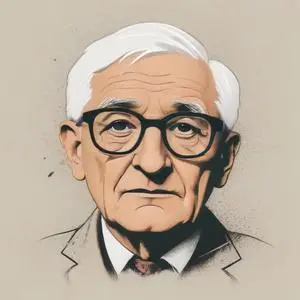
A prominent thinker who developed the concept of "communicative action" and explored the relationships between power, language, and social structures, influencing modern critical theory and sociology.
Jürgen Habermas, a renowned German philosopher and social theorist, is best known for his groundbreaking work on communicative rationality and the public sphere, which has had a profound impact on our understanding of modernity, democracy, and social evolution. His theoretical system, deeply rooted in the tradition of critical theory and pragmatism, has been instrumental in shaping the foundations of epistemology, social theory, and political philosophy.
Habermas was born on June 18, 1929, in Düsseldorf, Rhine Province, to a family of modest means. Born with a cleft palate, he underwent corrective surgery twice during childhood, an experience that would later influence his philosophical ideas on communication and dependency. Growing up in Gummersbach, near Cologne, Habermas was deeply affected by World War II, and his father's membership in the Nazi Party NSDAP would later become a point of reflection in his work.
Habermas' philosophical contributions can be summarized as an endeavor to reveal the possibility of reason, emancipation, and rational-critical communication latent in modern institutions and human capacity. His work is characterized by a strong emphasis on communicative rationality, which he sees as a means to bridge the gap between individual autonomy and collective deliberation. He is also known for his critiques of advanced capitalism, which he argues has led to the colonization of the lifeworld by the economic and administrative systems.
Habermas' concept of the public sphere is arguably his most influential contribution to social theory. He defines the public sphere as a realm where citizens engage in rational-critical discourse, free from the constraints of power and ideology. This idealized space is seen as essential for democratic deliberation, where individuals can come together to form public opinion and shape political decisions.
Habermas' work has had a profound impact on modern society, shaping the way we think about democracy, public opinion, and social evolution. His ideas have influenced fields beyond philosophy, including sociology, political science, and communication studies. His concept of the public sphere has informed political activism, from the civil rights movement to the anti-globalization protests.
Habermas' work is deeply rooted in the historical context of post-war Germany, where he sought to reconcile the legacy of the Enlightenment with the horrors of totalitarianism. His philosophical system has been shaped by the influences of American pragmatism, action theory, and poststructuralism, as well as the traditions of German critical theory, particularly the Frankfurt School.
Habermas' legacy extends far beyond the realm of philosophy, shaping the way we think about democracy, public opinion, and social evolution. His work continues to inspire scholars, activists, and policymakers, offering a vision of a more democratic and rational society, where individuals can come together to shape their collective future.
Born in 1903
A critical theorist who critiqued modern society, culture, and capitalism, arguing that they perpetuate inequality and stifle individual freedom. His work influenced many fields, from sociology to musicology.
Born in 1895
A critical theorist who developed the concept of Critical Theory, which critiques modern capitalist society and advocates for social change. Known for his work on authoritarianism and the culture industry.
Born in 1898
A critical theorist who challenged traditional notions of freedom, democracy, and consumerism, arguing that modern society is oppressive and dehumanizing.
Born in 1885
A German philosopher who explored the concept of utopia and the human desire for a better world, influencing Marxist thought and critical theory.
Born in 1892
A German philosopher and critic who analyzed the impact of technology on society, particularly in regards to art and culture, and is famous for his concept of "aura" in the age of mechanical reproduction.
Born in 1889
A German philosopher and academic who explored the meaning of existence, time, and human existence, influencing 20th-century philosophy with his concept of "Being-in-the-world".
Born in 1905
Existentialist philosopher and playwright who argued that humans have complete freedom to choose their actions and create their own meaning in life, influencing modern thought on morality and individual responsibility.
Born in 1908
A pioneering feminist philosopher who wrote extensively on ethics, politics, and gender, famously arguing that "one is not born, but rather becomes, a woman."
