


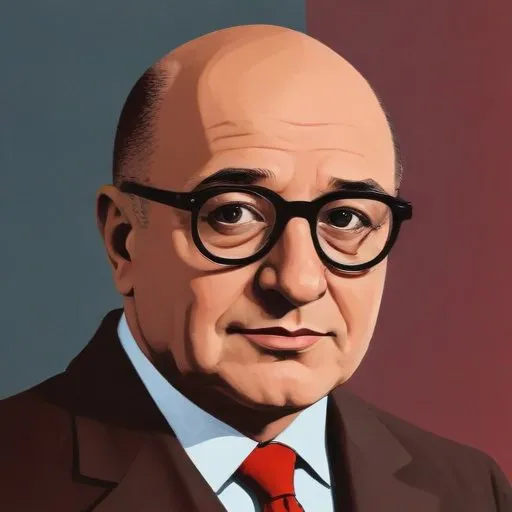
A critical theorist who developed the concept of Critical Theory, which critiques modern capitalist society and advocates for social change. Known for his work on authoritarianism and the culture industry.
Renowned for his groundbreaking work in critical theory, Max Horkheimer was a German philosopher and sociologist who shaped the intellectual landscape of the 20th century. Through his pioneering ideas, he addressed pressing issues of authoritarianism, militarism, economic disruption, environmental crisis, and the poverty of mass culture, leaving an indelible mark on modern thought.
Born on February 14, 1895, in Stuttgart, Germany, Max Horkheimer was the only son of Moritz and Babetta Horkheimer, a conservative, wealthy Orthodox Jewish family. Despite his father's expectations to take over the family business, Max's intellectual curiosity led him to pursue a different path.
His early relationships with Friedrich Pollock, a future academic colleague, and Rose Riekher, his father's personal secretary, would last a lifetime and shape his intellectual and personal trajectory.
Horkheimer's intellectual journey took a significant turn when he co-founded the Frankfurt School of social research, a hub for interdisciplinary inquiry and critical thinking. Alongside Theodor Adorno, Erich Fromm, and Herbert Marcuse, among others, Horkheimer developed the foundations of critical theory.
Through his work, he sought to understand the interplay between philosophy, sociology, and economics, examining how societal structures and power dynamics shape human experience. His magnum opus, Dialectic of Enlightenment (1947), co-authored with Adorno, remains a seminal work in critical theory.
Horkheimer's ideas have permeated various fields, inspiring new waves of thinkers and activists. His critiques of authoritarianism, militarism, and environmental degradation continue to resonate in contemporary debates.
His legacy extends beyond academia, influencing social movements, cultural critique, and progressive politics. As a pioneer of critical theory, Horkheimer's work continues to challenge dominant narratives and empower marginalized voices.
Max Horkheimer's contributions to critical theory have left an indelible mark on modern thought. His work continues to inspire new generations of scholars, activists, and thinkers, ensuring his ideas remain a vital force in shaping a more just and equitable world.
In the realm of philosophy, sociology, and cultural critique, Horkheimer's ideas remain a beacon of intellectual courage and curiosity, illuminating the complexities of modern society and inspiring us to strive for a better future.
Born in 1903
A critical theorist who critiqued modern society, culture, and capitalism, arguing that they perpetuate inequality and stifle individual freedom. His work influenced many fields, from sociology to musicology.
Born in 1898
A critical theorist who challenged traditional notions of freedom, democracy, and consumerism, arguing that modern society is oppressive and dehumanizing.
Born in 1900
A German psychologist and sociologist who developed the concept of "social character" and explored the relationship between psychology and society, known for his humanistic and socialist approach.
Born in 1892
A German philosopher and critic who analyzed the impact of technology on society, particularly in regards to art and culture, and is famous for his concept of "aura" in the age of mechanical reproduction.
97 Years Old
A prominent thinker who developed the concept of "communicative action" and explored the relationships between power, language, and social structures, influencing modern critical theory and sociology.
Born in 1905
Existentialist philosopher and playwright who argued that humans have complete freedom to choose their actions and create their own meaning in life, influencing modern thought on morality and individual responsibility.
