


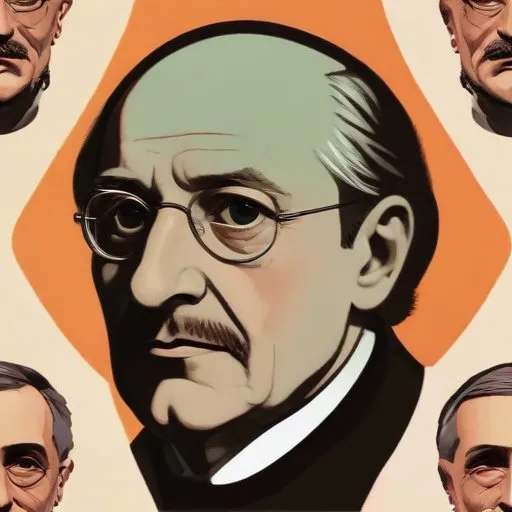
A critical theorist who analyzed the intersection of economics, politics, and culture, known for his work on authoritarianism and the role of technology in society.
Friedrich Pollock, a German social scientist and philosopher, is renowned for his pivotal role in shaping the Frankfurt School of neo-Marxist theory. As one of the founders of the Institute for Social Research in Frankfurt am Main, Pollock's work has had a profound impact on our understanding of Marxism, economy, and sociology.
Born on May 22, 1894, in Freiburg im Breisgau, Germany, Pollock was raised by a leather factory owner who had turned away from Judaism. This unique upbringing would later influence Pollock's perspective on philosophy and social science. During his education in finance from 1911 to 1915, Pollock met Max Horkheimer, with whom he formed a lifelong friendship and intellectual partnership.
In 1923, Pollock co-founded the Institute for Social Research alongside Felix Weil, a fellow Marxist. Weil's vision was to bring together diverse schools of Marxist thought, and the institute became a hub for intellectual discussion and debate. The institute's early years saw the participation of prominent thinkers such as György Lukács, Karl Korsch, and Karl August Wittfogel.
Pollock's research in the Soviet Union during the 1920s led to his seminal treatise, Attempts at Planned Economy in the Soviet Union 1917-1927. This work solidified his reputation as a leading expert on Marxist theory and economy. In 1928, Pollock took on the role of lecturer at the University of Frankfurt and temporarily replaced Carl Grünberg as Director of the institute.
Following the Nazi seizure of power in 1933, Pollock and Horkheimer went into exile, first in Geneva, then in London, Paris, and finally New York City. During this period, Pollock continued to contribute to the development of the Frankfurt School, shaping its thought and direction. In 1950, he returned to Frankfurt, taking part in the reestablishment of the Institute and resuming his role as director.
Pollock's work was characterized by a strong emphasis on empirical research and a critical approach to Marxism. He believed that Marxism should be adapted to the changing social and economic conditions of the time. His philosophical contributions have had a lasting impact on the development of critical theory and continue to influence contemporary thought.
The Frankfurt School, with Pollock at its helm, has had a profound influence on modern society. Its critiques of capitalism, authoritarianism, and social inequality continue to resonate with contemporary debates on issues such as globalization, democracy, and social justice.
Friedrich Pollock's life and work serve as a testament to the power of critical thought and intellectual courage. His legacy continues to inspire new generations of thinkers and scholars, ensuring that his vision for a more just and equitable society remains a beacon of hope for the future.
Born in 1898
A critical theorist who challenged traditional notions of freedom, democracy, and consumerism, arguing that modern society is oppressive and dehumanizing.
Born in 1903
A critical theorist who critiqued modern society, culture, and capitalism, arguing that they perpetuate inequality and stifle individual freedom. His work influenced many fields, from sociology to musicology.
Born in 1895
A critical theorist who developed the concept of Critical Theory, which critiques modern capitalist society and advocates for social change. Known for his work on authoritarianism and the culture industry.
Born in 1900
A German psychologist and sociologist who developed the concept of "social character" and explored the relationship between psychology and society, known for his humanistic and socialist approach.
Born in 1892
A German philosopher and critic who analyzed the impact of technology on society, particularly in regards to art and culture, and is famous for his concept of "aura" in the age of mechanical reproduction.
97 Years Old
A prominent thinker who developed the concept of "communicative action" and explored the relationships between power, language, and social structures, influencing modern critical theory and sociology.
Born in 1900
A German lawyer and theorist who developed influential ideas on political sociology, particularly on the intersection of politics and economics, and is known for his work on the concept of "behemoth" states.
