


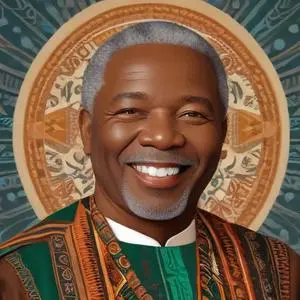
The second President of South Africa, a key figure in the country's transition from apartheid to democracy, known for his economic reforms and HIV/AIDS controversy.
Thabo Mbeki, the second democratic president of South Africa, is a name synonymous with the country's transition from apartheid to democracy. Serving as president from 1999 to 2008, Mbeki's leadership was marked by a commitment to economic growth, social justice, and African unity.
Born on June 18, 1942, in the Transkei region of South Africa, Mbeki was exposed to politics from a young age. His father, Govan Mbeki, was a renowned ANC intellectual and activist, who would later serve as a South African politician and writer. Mbeki's involvement with the African National Congress (ANC) began in 1956, when he joined the ANC Youth League.
Mbeki's rise through the ANC's ranks was marked by his diplomatic skills and ability to build relationships with international leaders. He played a key role in the organization's information and publicity section and later served as the ANC's official representative in several African countries. His experience as a diplomat would later serve him well in his role as president.
As president, Mbeki implemented several economic reforms aimed at stimulating growth, reducing poverty, and promoting black economic empowerment. His government's Growth, Employment, and Redistribution (GEAR) policy, introduced in 1996, aimed to reduce public debt, narrow the budget deficit, and promote economic growth. Under his leadership, South Africa experienced consistent economic growth, with the country's GDP increasing by an average of 3.5% per year between 1999 and 2008.
Mbeki was a strong advocate for African unity and played a key role in the formation of the African Union (AU). He also served as the chairman of the AU from 2002 to 2003. Internationally, Mbeki maintained good relations with the United States, Europe, and other African countries, and was a key player in several international forums, including the G20 and the Non-Aligned Movement.
In 1998, Mbeki married Zanele Mbeki, a businesswoman and philanthropist. The couple has no children together. Mbeki is a graduate of the University of Sussex in the UK, where he earned a master's degree in economics.
Mbeki's philosophical beliefs were shaped by his experiences as a young man in exile, where he was exposed to the works of African nationalist leaders and intellectuals. He has written extensively on the importance of African unity, social justice, and economic empowerment.
Mbeki's presidency had a profound impact on modern South African society. He implemented several policies aimed at promoting social justice, including the extension of basic services such as water, electricity, and sanitation to millions of South Africans. He also introduced several initiatives aimed at promoting black economic empowerment and reducing poverty.
Despite his many achievements, Mbeki's presidency was not without controversy. He faced criticism for his government's handling of the HIV/AIDS epidemic, and his stance on the issue of Zimbabwe's political crisis. Mbeki's leadership style was also criticized for being aloof and out of touch with the needs of ordinary South Africans.
Thabo Mbeki's legacy is complex and multifaceted. While he is remembered for his role in shaping South Africa's democracy, he is also criticized for his handling of several key issues during his presidency. Despite this, Mbeki remains a significant figure in South African politics and a respected leader on the African continent.
Born in 1918
A South African lawyer and politician who fought against apartheid, becoming the country's first black president and a symbol of racial reconciliation, earning a Nobel Peace Prize. He's a beacon of hope and freedom.
Born in 1917
A leading figure in the fight against apartheid, he served as President of the African National Congress and played a crucial role in mobilizing international opposition to the racist regime.
Born in 1912
A leading figure in the fight against apartheid, he was a co-founder of the African National Congress and spent 25 years in prison for his activism. He played a key role in shaping South Africa's transition to democracy.
Born in 1926
A Lithuanian-born South African revolutionary who fought against apartheid, leading the armed wing of the African National Congress and playing a key role in the country's transition to democracy.
90 Years Old
The last State President of apartheid-era South Africa who led the country's transition to democracy and was awarded the Nobel Peace Prize for his efforts. He's known for his role in releasing Nelson Mandela from prison and dismantling the apartheid system.
84 Years Old
The 4th President of South Africa, a controversial figure known for his corrupt regime and multiple scandals, including bribery and racketeering charges. He was also a key figure in the fight against apartheid.
73 Years Old
The fifth President of South Africa, a leader who has played a crucial role in the country's transition to democracy and has been a key figure in the fight against apartheid. He is also a successful businessman and entrepreneur.
77 Years Old
The 3rd President of South Africa, a key figure in the country's transition from apartheid to democracy, known for his role in shaping the nation's post-apartheid era.
