


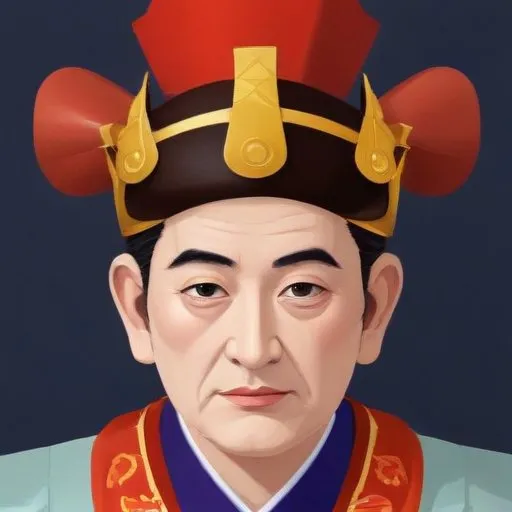
The 48th emperor of Japan, who reigned from 1817 to 1846 and is remembered for his efforts to reform the Tokugawa shogunate and improve relations with Western nations.
Emperor Nink, posthumously honored as Ninktenn, was the 120th emperor of Japan, reigning from 1817 to 1846. During his reign, he made significant efforts to revive and restore traditional court rituals and practices, earning him recognition as a champion of imperial traditions.
Born on March 16, 1800, as Ayahito, Emperor Nink was the fourth son of Emperor Kkaku. He was the only child among sixteen others to survive into adulthood. In 1809, he was named crown prince and was adopted by his father's chief wife, Imperial Princess Yoshiko, also known as Shin-Seiwa-in.
Enthroned as Emperor on October 31, 1817, following his father's retirement, Emperor Nink attempted to revive certain court rituals and practices according to his father's wishes. One of his notable innovations was the establishment of the Gakushuin, an educational institution for the nobility.
Emperor Nink had fifteen children from various concubines, but only three of them lived to adulthood. His fourth son, Imperial Prince Osahito, succeeded him as the next Emperor upon his death in 1846.
Emperor Nink's reign marked a significant turning point in Japanese history, as it saw the beginning of the end of the Bakumatsu period, which would eventually lead to the Meiji Restoration. His efforts to revive traditional court rituals and practices helped to preserve Japan's cultural heritage and paved the way for future emperors.
Emperor Nink's reign took place during a time of great turmoil in Japan, marked by natural disasters, famine, corruption, and increasing Western interference. Despite these challenges, he managed to maintain the dignity of the imperial throne and promote cultural and literary development.
Emperor Nink's legacy as a champion of imperial traditions continues to inspire and educate future generations about Japan's rich cultural heritage.
Born in 1852
Modernized Japan's government and society, transforming it from a feudal state to a modern, industrialized nation. He oversaw rapid modernization and westernization.
Born in 1837
The last shogun of the Tokugawa dynasty, who oversaw Japan's transition from feudalism to modernity and surrendered to imperial forces, ending the samurai era. He's known for his attempts to reform and modernize Japan.
Born in 1828
Leader of the Satsuma Rebellion, a samurai who fought against the modernization of Japan, seeking to preserve traditional ways. He's known for his bravery and tragic demise.
