


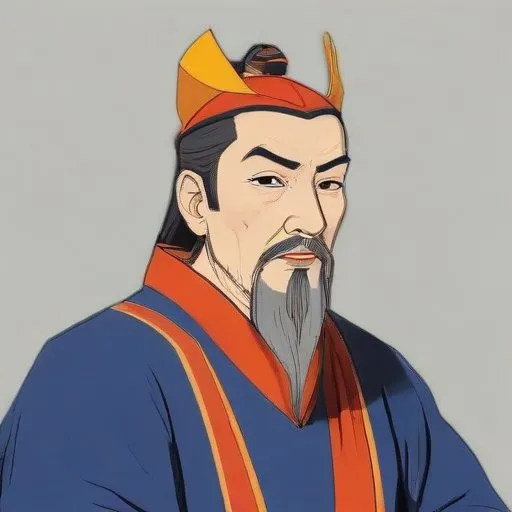
The last emperor of the Northern Song dynasty, known for his brief and tumultuous reign marked by military defeats and eventual capture by the Jurchen-led Jin dynasty. He's infamous for his incompetence and poor decision-making.
Emperor Qinzong of Song, the ninth ruler of the Song Dynasty, is remembered for his tumultuous reign marked by military defeats, internal power struggles, and the eventual capture by the Jurchen-led Jin Dynasty. His reign, which lasted from 1125 to 1127, was a turning point in Chinese history, marking the beginning of the end of the Northern Song Dynasty.
Born as Zhao Huan in 1100, Qinzong was the son of Emperor Huizong, the eighth ruler of the Song Dynasty. Growing up in a life of luxury, he was groomed to take the throne from a young age. However, his father's indulgence and lack of discipline led to Qinzong's eventual downfall. He was known for his reckless spending, extravagance, and lack of interest in state affairs, which ultimately contributed to the decline of the dynasty.
In 1125, following the death of his father, Qinzong ascended to the throne. His reign was marred by internal power struggles and external threats from the Jurchen-led Jin Dynasty. Despite his efforts to reform the military and strengthen the dynasty's defenses, Qinzong's armies suffered a series of devastating defeats at the hands of the Jin Dynasty. The most notable of these was the Battle of Caishi, which resulted in the loss of the Song capital, Kaifeng.
In 1127, Qinzong was captured by the Jin Dynasty during the Second Siege of Kaifeng. He was exiled to the Jin capital, Tianjing, where he spent the remainder of his life under house arrest. His capture marked the end of the Northern Song Dynasty and the beginning of the Southern Song Dynasty, which would eventually be established by his brother, Emperor Gaozong.
Despite his tumultuous reign, Qinzong was known for his patronage of the arts and his interest in Daoist and Buddhist philosophies. He was a skilled calligrapher and poet, and his works continue to be studied by scholars today.
Emperor Qinzong's reign marked a significant turning point in Chinese history, marking the transition from the Northern to the Southern Song Dynasty. His capture by the Jin Dynasty led to a period of fragmentation and division in China, which would eventually be reunified under the Mongol-led Yuan Dynasty. Today, Qinzong is remembered as a cautionary tale of the importance of wise leadership and the devastating consequences of neglect and extravagance.
Emperor Qinzong's reign serves as a reminder of the importance of wise leadership and the devastating consequences of neglect and extravagance. His capture by the Jin Dynasty marked a significant turning point in Chinese history, leading to a period of fragmentation and division that would eventually be reunified under the Mongol-led Yuan Dynasty. Today, Qinzong's legacy continues to be studied by historians and scholars, serving as a cautionary tale of the importance of responsible leadership.
Born in 1130
A leading figure in Confucianism, he synthesized Confucian classics into a coherent philosophical system, influencing East Asian thought for centuries. His teachings emphasized moral cultivation and self-reflection.
